
How to Build a Content Marketing Strategy for Steady Growth
Creating content is relatively easy. Creating useful content consistently, reaching the right readers and turning that attention into steady website growth requires a clear plan.
That plan is your content marketing strategy.
You do not need a large team, expensive software or daily posts. Content marketing for beginners can start with a simple strategy built around the right audience, helpful topics and a realistic schedule.
This content marketing strategy guide explains how to create a beginner-friendly plan that supports your website, builds trust and attracts targeted visitors over time. It also fits into the wider methods covered in the Traffic and Growth guide, where you can learn how content, SEO, social media and email marketing work together.
The following content marketing strategy steps will help you move from random publishing to a clear and manageable plan.
Affiliate disclosure: This article may contain affiliate links. If you purchase through one of these links, I may earn a commission at no additional cost to you. I only recommend resources that I believe may be useful for beginners.
What Is a Content Marketing Strategy?
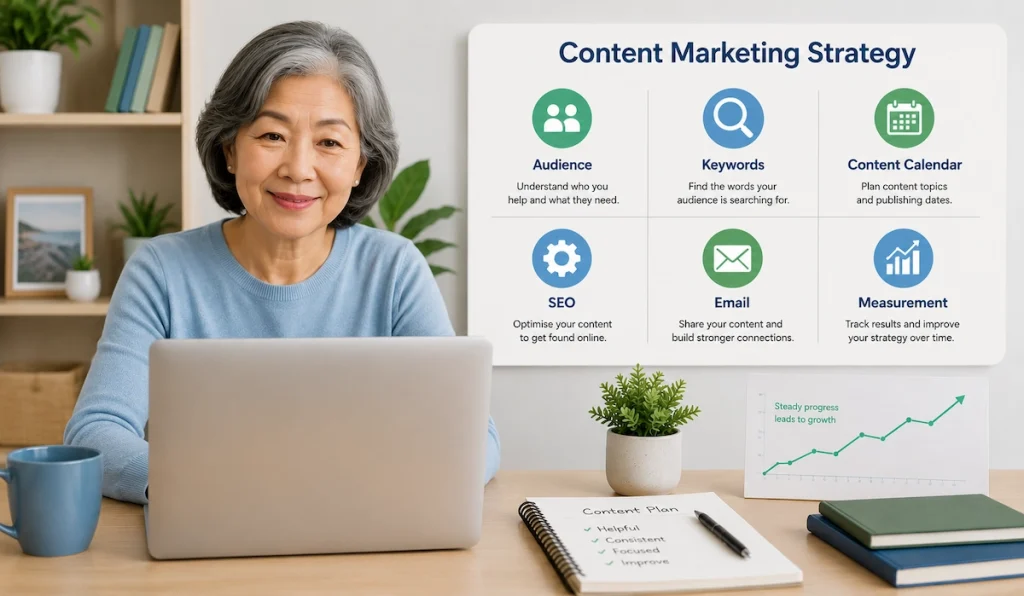
A content marketing strategy is a plan for creating, publishing and promoting useful content for a specific audience.
From there, a simple content marketing plan puts the strategy into action by organising your topics, publishing schedule, promotion methods and measurable next steps.
It answers practical questions:
- Who are you trying to help?
- What problems or questions do they have?
- What topics should your website cover?
- Which types of content will you create?
- How often can you publish?
- How will people find the content?
- What should readers do next?
- How will you measure progress?
Without a strategy, it is easy to jump between unrelated topics or create articles that do not support your goals. A clear plan gives every page a purpose.
Your content may help a reader understand a problem, learn a skill, compare options or choose a product. When each piece has a clear role, your website becomes more useful and easier to grow.
Useful original content can also give other website owners something worth referencing. My beginner guide explains how content can gradually earn backlinks without mass outreach.
Why Content Marketing Matters
Content marketing is useful when you are building an online business with a limited budget.
A helpful article can answer questions people are already asking. It can introduce readers to your website, demonstrate your knowledge and guide them to another relevant page.
Content also supports SEO, internal linking, email marketing, social media and product recommendations. The goal is not to publish as much as possible. It is to build a useful collection of connected pages that serves your audience.
Step 1: Choose One Clear Goal
Decide what you want your content to achieve.
Your goal might be to:
- attract search traffic;
- build an email list;
- explain a product or service;
- support affiliate recommendations;
- establish trust; or
- guide beginners through a learning path.
You can have several goals, but one should be the main priority.
For example, your primary goal may be to attract beginners who want to build an online business. Your secondary goal may be to encourage them to read another guide, join your email list or explore a recommended resource.
Before creating an article, ask:
What useful result should this page provide, and what sensible next step should it offer?
This question helps you avoid publishing content simply because you feel that you need another blog post.
Step 2: Define Your Audience
A strong digital content marketing strategy begins with a specific reader.
Trying to write for everyone usually produces vague content. Instead, identify:
- their experience level;
- the result they want;
- the problem stopping them;
- the questions they ask;
- the mistakes they fear; and
- the time, budget or confidence they have.
For a beginner online marketing website, the reader may feel overwhelmed by technical language, conflicting advice and too many tools. Your content should therefore be clear, practical and organised into manageable steps.
A short audience statement is enough:
I create beginner-friendly content for people who want to build an online business but need clear, affordable and practical guidance.
Use that statement to check whether each planned topic belongs on your website.
When you understand the reader, it becomes easier to choose the right language, examples, article length and next step.
Complete your audience research before building the rest of your content plan. This guide shows how to identify your target audience using seven practical steps.
Step 3: Select Main Topics and Content Pillars
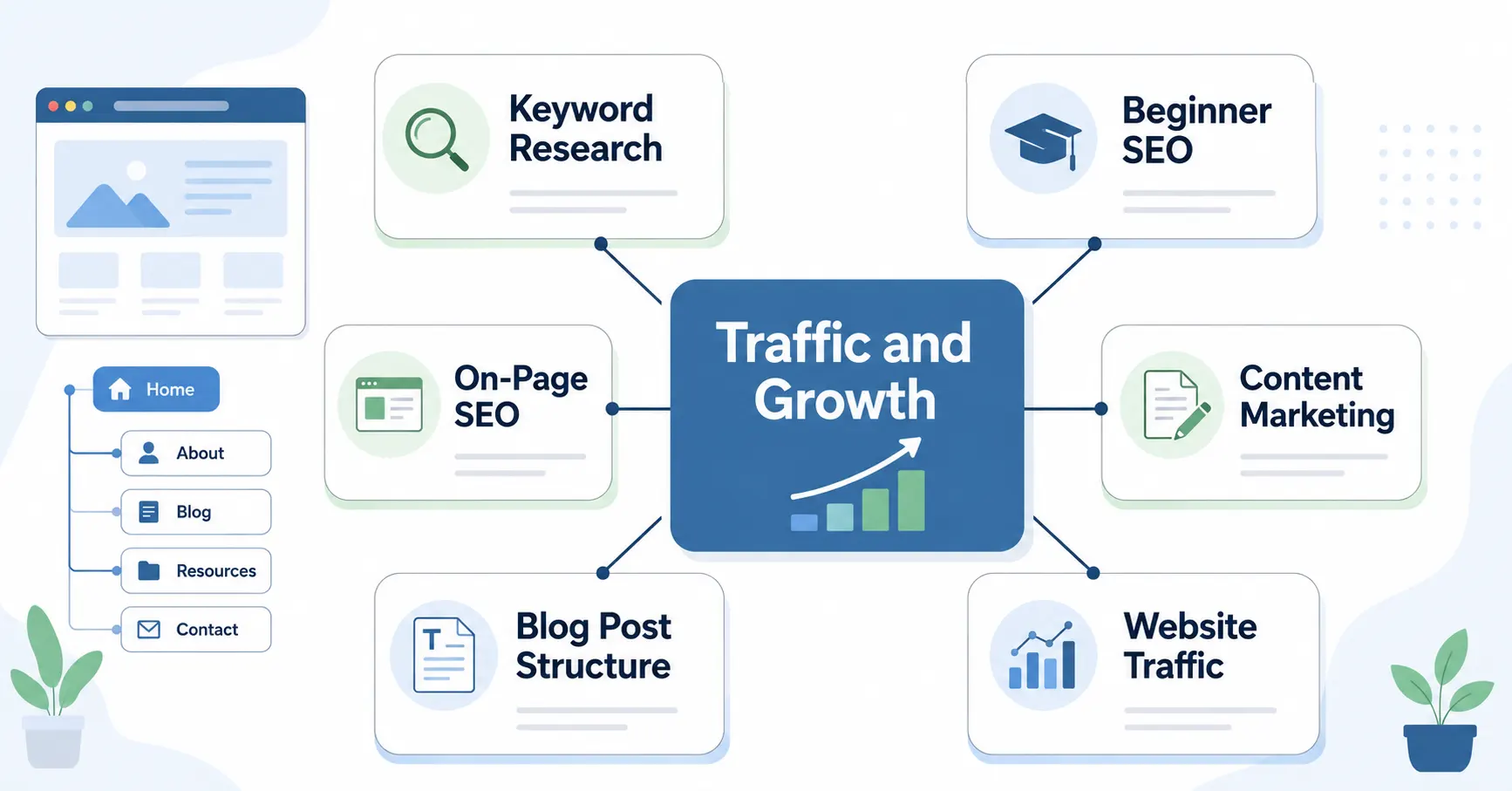
Choose a small number of broad subjects that support your audience and website. These are often called content pillars.
Each pillar is supported by narrower articles that explore one part of the main subject. The guide to blog SEO and traffic explains how search engines discover and understand those connected pages.
For example:
- Online Business Foundation
- Affiliate Marketing for Beginners
- Traffic and Growth
Before expanding a content cluster, it helps to have a clear structure for your pillar pages and supporting posts.
The Traffic and Growth pillar could be supported by articles about keyword research, beginner SEO, on-page optimisation, content marketing, blog post structure and increasing website traffic.
This structure prevents random publishing. It also gives you a simple test for new ideas:
Does this topic support one of my main pillars?
Each supporting article should explore one subject in detail and link back to its pillar. The pillar should also link to the supporting posts, creating a clear learning path for readers.
Learn how to build those connections in this practical guide to creating an internal linking strategy.
Instead of having a collection of isolated articles, you begin building a connected content library.
Once you have selected your topics, follow this beginner guide to learn how to write a blog post from outline to publication.
As your content library grows, you can also look for content gaps to find missing questions and strengthen each topic cluster.
Step 4: Use Keyword Research and Search Intent
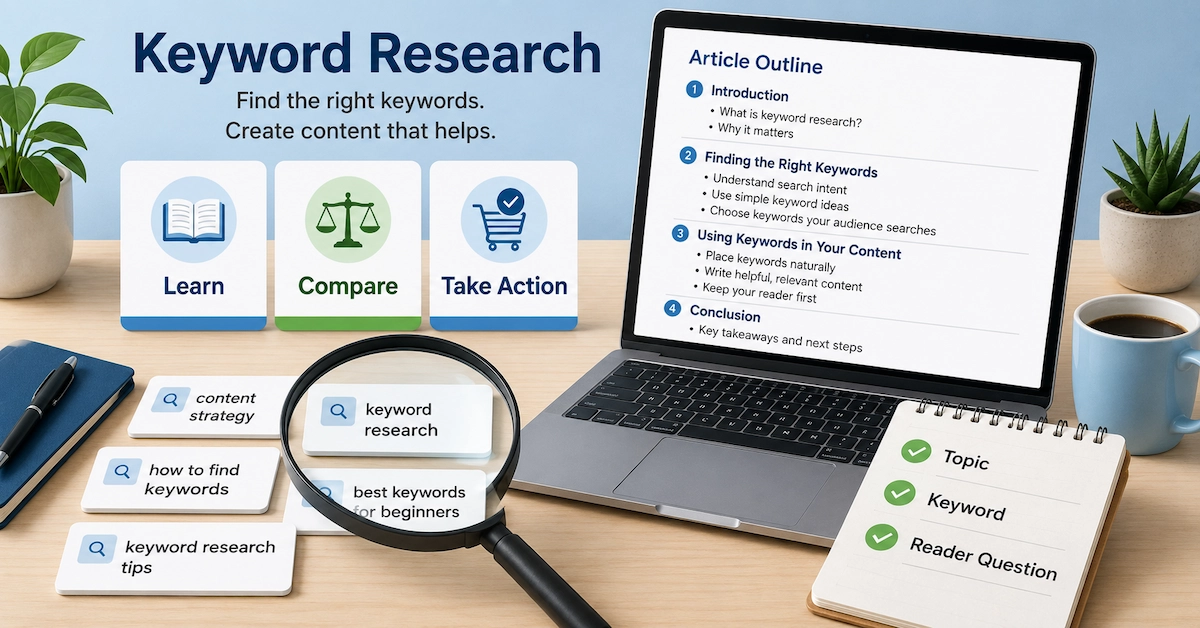
Keyword research helps you understand how people describe the information they want.
A strong content marketing strategy for SEO connects the questions your audience asks with useful pages that answer those questions clearly.
For this topic, related phrases include:
- content marketing strategy for SEO;
- content marketing strategy examples;
- small business content marketing strategy;
- content marketing strategy steps;
- how to make a content marketing strategy; and
- content marketing for beginners.
Choose one focus keyword and use supporting phrases only where they fit naturally.
These differences can be subtle when you are beginning. Follow this practical guide to matching content with search intent before adding the topic to your content calendar.
Do not try to place every keyword into every section. Repeating phrases too often can make an article awkward and less useful.
Search intent is just as important as the keyword.
Your SEO content marketing strategy should therefore focus on satisfying the reader’s intent, not simply repeating a keyword.
- Someone searching for “what is a content marketing strategy” wants an explanation.
- A person searching for “content marketing strategy steps” wants a process.
- Someone searching for examples wants to see how a plan works in practice.
A complete beginner guide can meet these needs by including a definition, clear steps and a practical example.
The purpose of keyword research is not simply to find phrases with search volume. It is to understand the questions behind those phrases and create the most useful page you can.
Step 5: Choose Useful Content Formats
Blog posts are valuable, but your strategy may also include:
- beginner guides;
- tutorials;
- checklists;
- frequently asked questions;
- comparisons;
- honest reviews;
- email lessons;
- short videos; and
- downloadable templates.
Your content creation strategy should prioritise formats you can produce consistently and that match the way your audience prefers to learn.
- A detailed guide works when a topic needs explanation.
- A checklist provides a quick reference.
- A comparison helps people choose between options.
- An FAQ answers smaller questions that may not need separate articles.
Begin with one main format you can create consistently.
For many beginners, this will be useful blog articles supported by simple images, email updates and selected social posts.
You can add more formats later. There is no need to begin with a blog, video channel, podcast, newsletter and several social media accounts at the same time.
Step 6: Create a Realistic Content Calendar
Consistency is easier when your schedule matches your available time.
Do not commit to daily content if you cannot maintain it. One useful article every week or two is better than an ambitious plan that quickly stops.
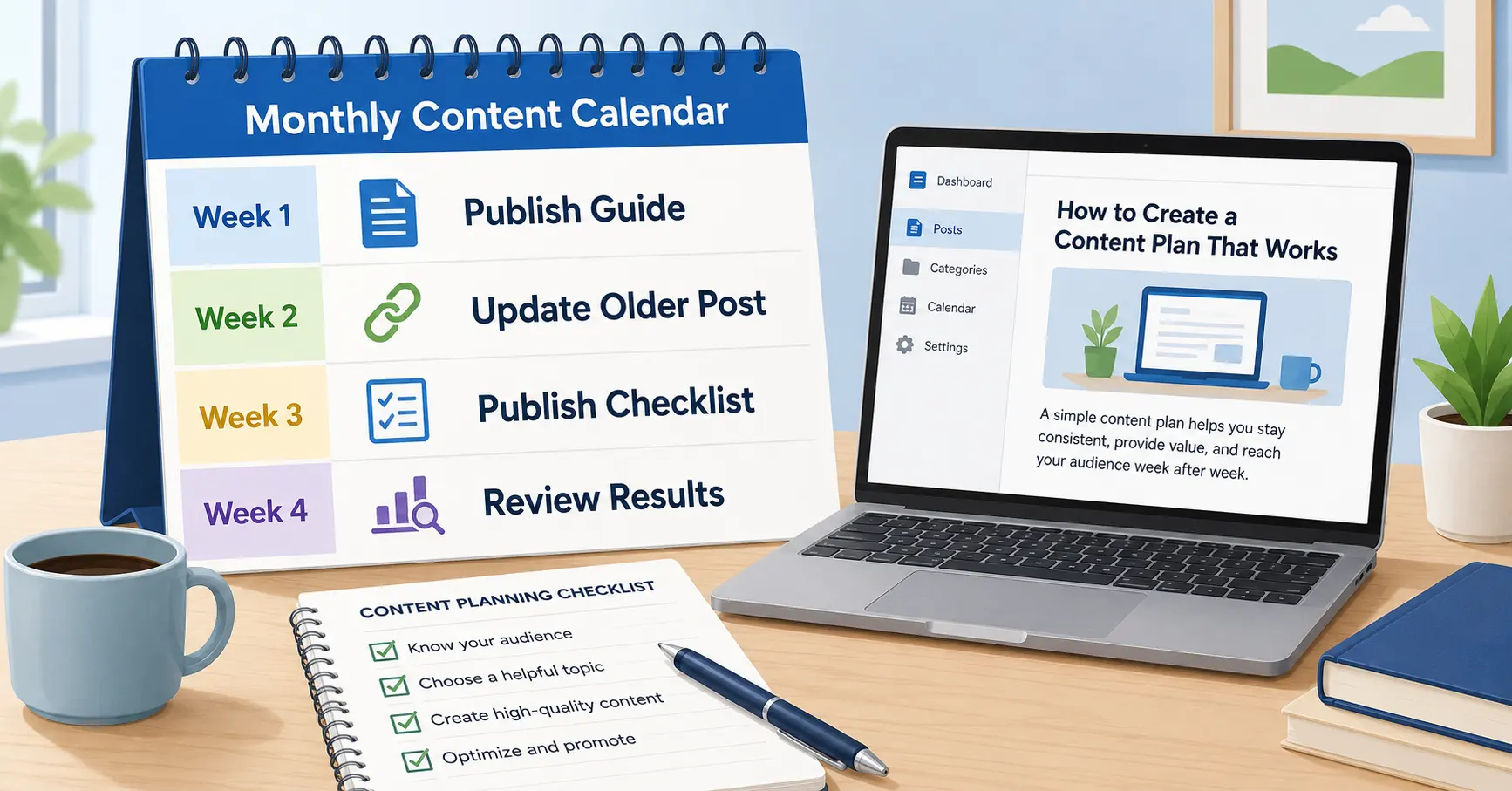
A simple monthly calendar could include:
- Week 1: Publish an educational article.
- Week 2: Update an older post and add internal links.
- Week 3: Publish a supporting guide or checklist.
- Week 4: Review performance and plan the next month.
For each article, record:
- the working title;
- focus keyword;
- audience question;
- content format;
- planned publishing date;
- related pillar page; and
- next-step CTA.
A spreadsheet, calendar or notebook will work. Keep your ideas and publishing dates organised in one place.
A realistic schedule also gives you time to research, edit, add images, check links and improve the article before publishing it.
Step 7: Create Helpful, Trustworthy Content
Each article should:
- answer the main question early;
- use a clear title and headings;
- explain unfamiliar terms;
- provide practical steps;
- use examples where helpful;
- avoid exaggerated promises;
- link to relevant pages; and
- finish with a logical next step.
Write for someone learning the topic for the first time. Do not assume they understand every tool or term.
Helpful content does not need to be unusually long. It needs to solve the reader’s problem clearly.
Google also recommends creating helpful, reliable, people-first content that leaves readers feeling they have learned enough to move closer to their goal.
A 1,500-word article that answers the question properly can be more useful than a 4,000-word article filled with repetition.
Trust also matters. Be open about affiliate relationships, recommend products carefully and avoid suggesting that one method guarantees traffic or income.
Readers are more likely to return when they believe your main purpose is to help them make an informed decision. These steps to build trust online can help keep your content honest and reader-focused.
Step 8: Publish, Promote and Repurpose
Publishing is not the final step. People still need to discover the article.
After publishing, you can:
- link to it from the relevant pillar;
- add links from older related articles;
- share it with email subscribers;
- turn key lessons into social posts using a beginner social media marketing plan;
- create a checklist from the main steps; or
- update another page with a link to the guide.
Repurposing adapts one useful idea to other formats.
A nine-step guide could become a checklist, email series, short posts and video outline.
You do not have to create an entirely new idea every time you communicate with your audience. You can take one useful subject and present different parts of it in ways that suit different platforms.
Step 9: Measure and Improve
You do not need to track dozens of numbers.
Begin with:
- website visits;
- search impressions and clicks;
- internal link clicks;
- email sign-ups;
- resource or product clicks; and
- pages that attract returning visitors.
Review results over a meaningful period rather than judging an article after a few days.
You can track those search impressions and clicks using this beginner guide to Google Search Console.
Look for useful lessons:
- Which topics attract the right readers?
- Which pages encourage another click?
- Which titles receive impressions but few visits?
- Which useful posts need stronger internal links?
- Which articles could be expanded or updated?
- Which CTAs receive the most interest?
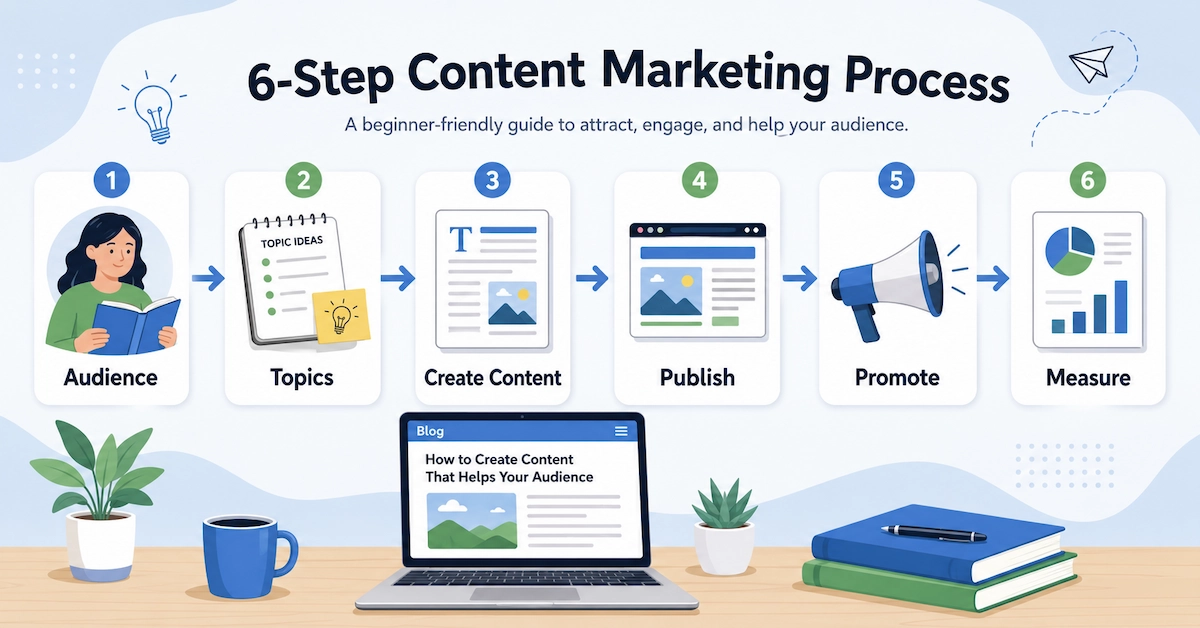
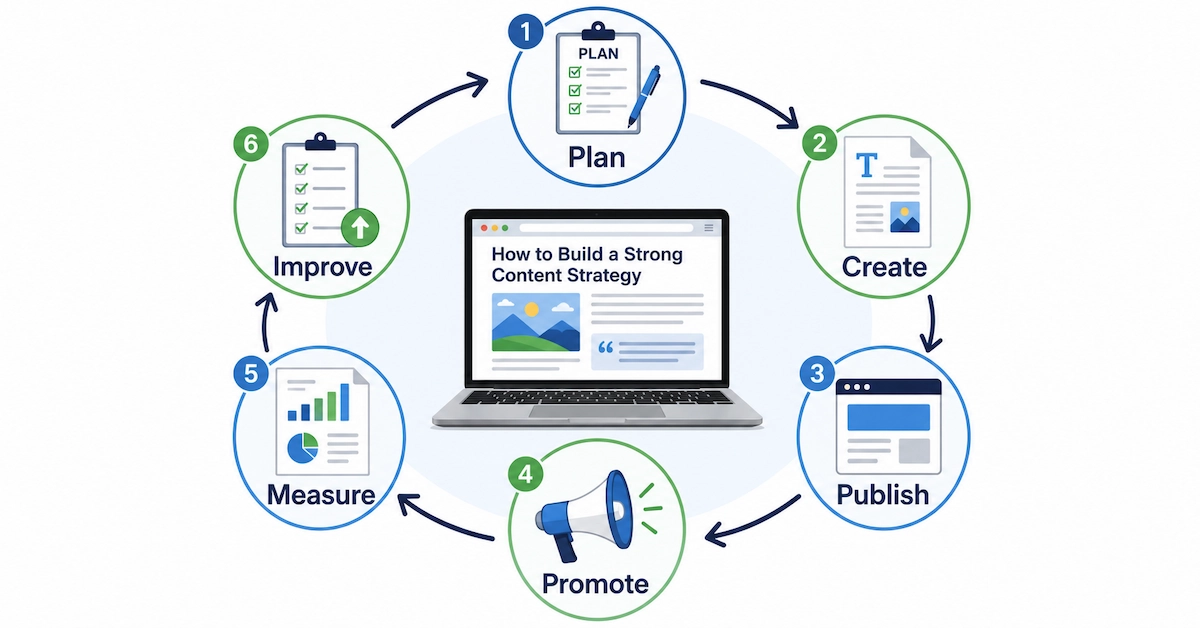
Content marketing improves through a repeated cycle:
Plan → Create → Publish → Promote → Measure → Improve
Your first plan is a starting point. It should become stronger as you learn what your audience finds useful.
Once your content plan is in place, follow these beginner steps to increase website traffic organically.
Simple Content Marketing Strategy Examples for Beginners
Here is the first of several possible content marketing strategy examples: a beginner website focused on building an online business.
Audience: People who want to start an online business but feel overwhelmed by technical advice.
Primary goal: Attract targeted visitors through useful beginner content.
Main pillars: Online Business Foundation, Affiliate Marketing and Traffic and Growth.
Publishing schedule: Two detailed supporting posts each month.
Content types: Guides, checklists, FAQs and honest resource reviews.
Promotion: Internal links, email updates and selected social posts.
Main CTA: Read the next guide, join the email list or explore a suitable training resource.
Affiliate website example: Publish one educational guide and one comparison article each month. Link both to the relevant affiliate marketing pillar, promote them through email and measure search traffic, internal clicks and affiliate-link engagement.
If affiliate marketing is your main business model, use these affiliate marketing content ideas to plan the guides, reviews, comparisons and tutorials in that schedule.
Review schedule: Check performance monthly and complete a deeper review every three months.
This is intentionally simple.
A small business content marketing strategy should be manageable before it becomes advanced. You can expand it when you have more content, experience and information about what your audience needs.
Want More Guidance as You Build Your Strategy?
Learning content marketing is easier when you have a clear path and practical support.
For additional training, tools and guidance on building traffic and growing an online business, explore CB Profit Club and see whether it suits your current goals.
You do not need to use every strategy at once. Focus on the next useful step and improve your content as your experience grows.
Common Content Marketing Mistakes
Publishing Unrelated Topics
Every article should support your audience and one of your main content pillars.
Targeting Keywords Without Helping Readers
Keywords can guide the topic, but useful information must remain the priority.
Providing No Next Step
Direct readers to a relevant article, resource, email sign-up or other useful action.
Ignoring Older Posts
Updating headings, examples, images and internal links can improve an existing page.
For a complete refresh process, follow this guide to updating an older blog post.
Promoting Too Aggressively
Helpful education should come before recommendations. Give readers enough information to make their own decisions.
Giving Up Too Quickly
A connected content library takes time to build. Continue measuring, updating and improving your work.
Frequently Asked Questions

How do you make a content marketing strategy?
To understand how to make a content marketing strategy, start by defining your goal and audience.
Define your goal and audience, choose your core topics, research relevant keywords, select useful formats and create a realistic publishing calendar. Promote each piece, measure the results and improve the plan over time.
How often should a beginner publish content?
Choose a schedule you can maintain. One strong article every week or two can build momentum. Consistency and usefulness matter more than publishing every day.
What is the difference between a content strategy and a content calendar?
A content strategy explains who you are helping, what you will publish, why you are creating it and how it supports your goals. A content calendar records individual topics, formats and publishing dates.
How does content marketing support SEO?
Content marketing creates useful pages that answer search questions. SEO helps organise and optimise those pages so readers and search engines can understand them. Keyword research, search intent, headings and internal links help the two work together.
Can content marketing work without social media?
Yes. Your strategy can focus on search traffic, email, referrals and internal links. Social media can help with promotion, but you do not need to use every platform.
How long does a content marketing strategy take to work?
There is no fixed timeline. Results depend on the topic, competition, content quality, website authority, promotion and consistency. Look for gradual improvement rather than immediate results.
Final Thoughts
A successful content marketing strategy does not begin with more content. It begins with clearer decisions. Use the guide on how to write blog posts that get traffic when you are ready to turn the plan into individual articles.
- Choose an audience.
- Define a goal.
- Build your main topics.
- Research what readers need.
- Publish useful content on a schedule you can maintain.
- Then connect, promote and improve those pages over time.
You do not need to master every channel. Start with a simple plan and make each article genuinely helpful.
Next guide to continue with:
For the wider system that connects content marketing with SEO, email, social media and other traffic methods, continue with the complete Traffic and Growth guide.
Continue Your Online Business Journey
Explore more resources to help you build and grow your online business.
Recommended Reading
New Here?
Start with the beginner roadmap and learn the fundamentals of affiliate marketing and online business.
Start HereReady For The Next Step?
Discover the complete system I use to build and grow an online business.
Join Profit Club