


How to Do Keyword Research for Your Website and Blog
Keyword research can seem complicated when you are new to building a website.
You may hear people talking about search volume, keyword difficulty, search intent, competition and long-tail keywords.
Before long, it can feel as though you need to become an SEO expert before you can publish your first article.
You don’t.
Keyword research is simply the process of discovering what people are searching for and deciding which of those searches your content can answer.
When it is done properly, keyword research helps you create articles around real questions instead of guessing what your audience might want to read.
This beginner-friendly guide explains how to do keyword research, how to evaluate keyword ideas and how to choose suitable topics for a new or growing website. The broader SEO for beginners guide shows where keyword research fits within the full optimisation process.
Affiliate disclosure: This article may contain affiliate links. If you purchase through one of these links, I may earn a commission at no additional cost to you. I only recommend resources that I believe may be useful for beginners.
What Is Keyword Research?
Keyword research is the process of finding the words and phrases people enter into search engines such as Google.
These searches can be short and broad:
- Affiliate marketing
- Website traffic
- Email marketing
They can also be longer and more specific:
- How to start affiliate marketing for beginners
- How to increase website traffic without paying for ads
- Best email marketing tools for a new blog
A keyword does not have to be a single word. In SEO, a keyword can be an entire question or phrase.
Learning SEO keyword research for beginners does not require complicated software or large spreadsheets.
The goal is to identify searches that are:
- Relevant to your website
- Helpful to your target audience
- Suitable for your level of authority
- Clear enough to answer properly
- Connected to your products, services or recommendations
Good keyword research is not about inserting popular phrases into an article as many times as possible.
It is about understanding the problem behind the search and creating the most useful answer you can.
You can learn how to do keyword research with free tools by using Google suggestions, related searches and Search Console data.
Once your site has search data, Google Search Console for beginners can show the actual queries your pages are appearing for.
Why Keyword Research Matters
Publishing content without keyword research is a little like putting up road signs without knowing where people want to go.
You may create a well-written article, but it could struggle to attract visitors because very few people search for that subject or because the article does not match what searchers expect to find.
Keyword research helps you make better content decisions. A content marketing strategy helps turn those decisions into a realistic publishing plan.
It can help you:
- Discover what your audience wants to know
- Find questions suitable for new articles
- Organise posts into related topic groups
- avoid topics that are too broad or competitive
- Choose clear titles and headings
- Create content with a realistic chance of attracting traffic
It also helps you build topical authority.
Looking at practical keyword research examples can make the process easier to understand.
For example, a website about affiliate marketing might begin with a main pillar guide and then publish supporting articles about choosing a niche, finding affiliate programs, creating useful content and attracting website traffic.
Each article answers a different question while supporting the broader subject.
Understanding keyword search intent helps you create the type of page people expect to find.
For more help building this part of your website, visit the Traffic and Growth for Beginners pillar guide.
Step 1: Start With Your Main Website Topics
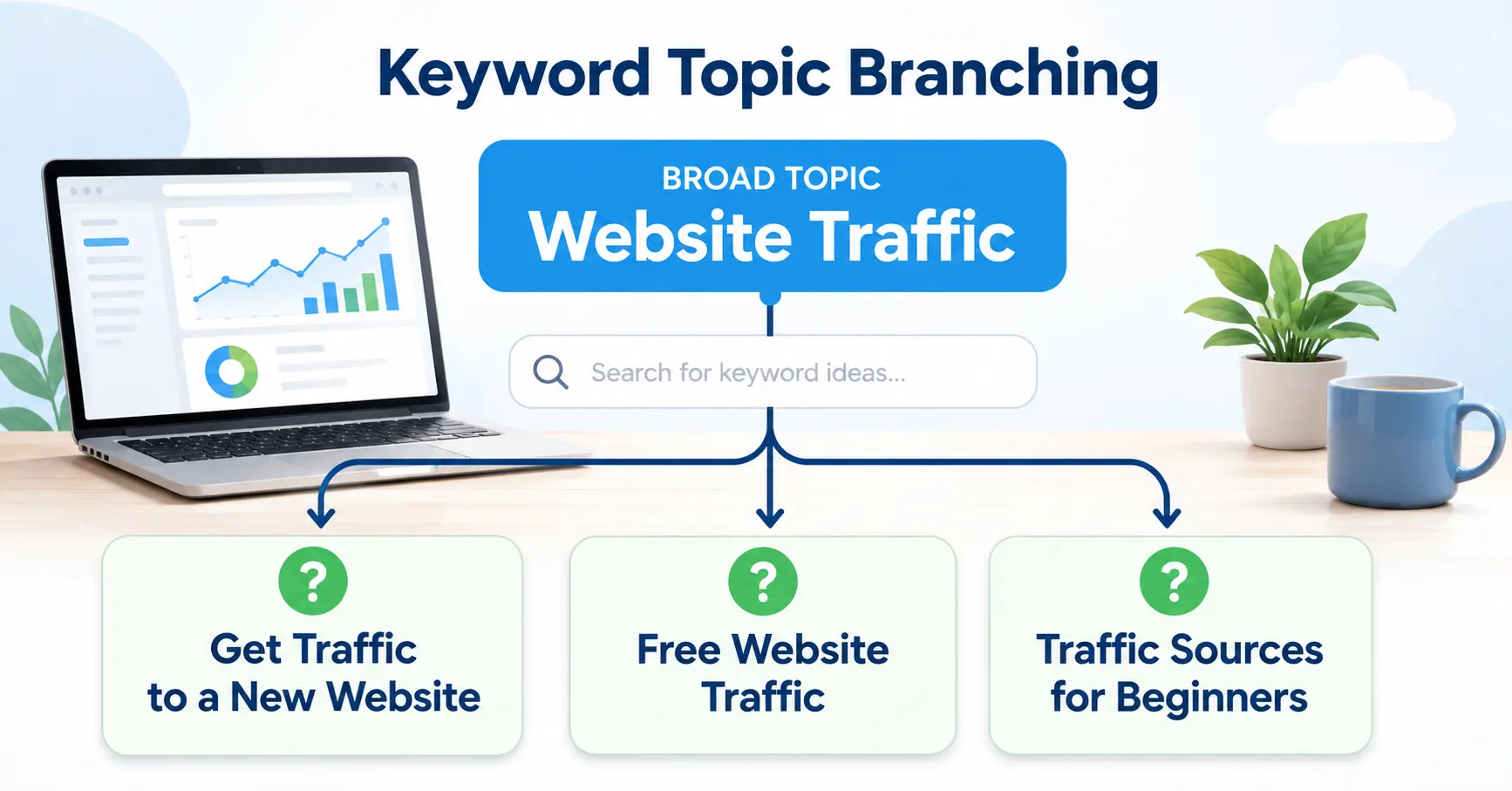
Before using a keyword research tool, write down the main topics covered by your website.
These starting ideas are often called seed topics or seed keywords because they can be used to generate more specific questions, phrases and future content ideas.
For a beginner online business website, seed topics might include:
- Starting an online business
- Affiliate marketing
- Blogging
- Website traffic
- Search engine optimisation
- Email marketing
- Content creation
Do not begin with hundreds of ideas. Choose a few topics that are closely connected to your website’s purpose.
For each topic, consider what a beginner might want to know.
Under “website traffic,” for example, people may ask:
- How do I get traffic to a new website?
- Can I get website traffic for free?
- How long does SEO traffic take?
- What is the best traffic source for beginners?
- How often should I publish blog posts?
These questions can become keyword ideas and future articles.
Step 2: Turn Broad Topics Into Specific Questions
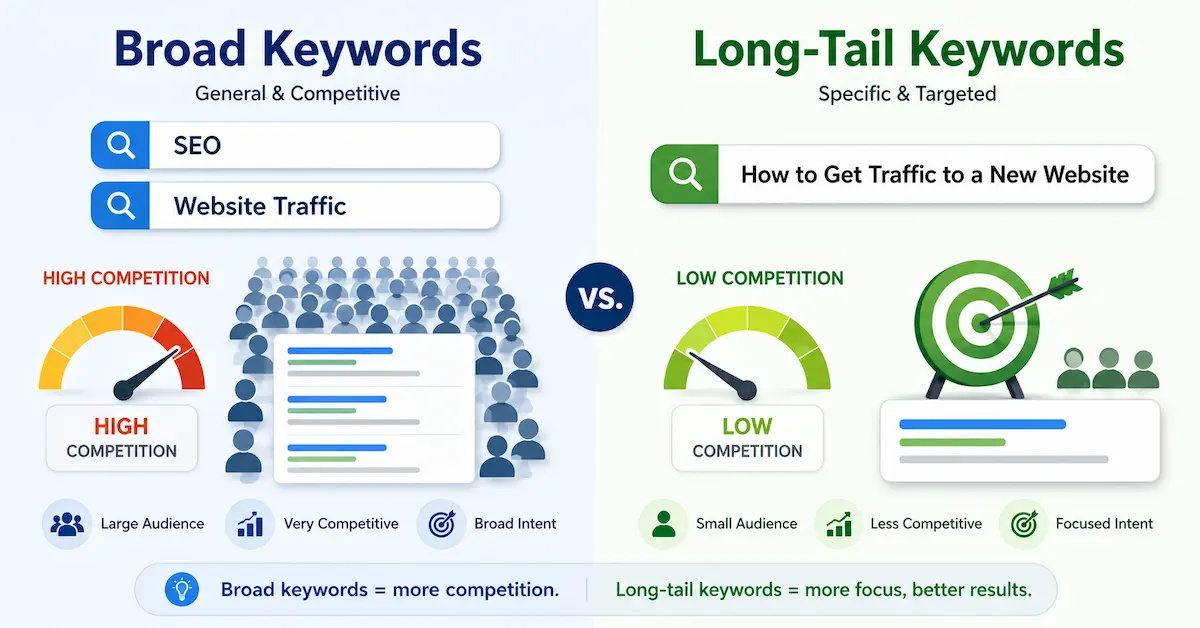
Broad keywords are often difficult for a new website to target.
A phrase such as “SEO” could refer to hundreds of different subjects. Someone searching for it might want a definition, a course, an agency, a tool or the latest industry news.
A more specific phrase gives you a clearer idea of what the searcher needs.
Compare these examples:
Broad keyword: Keyword research
More specific keyword: How to do keyword research for a blog post
Broad keyword: Website traffic
More specific keyword: How to increase website traffic for free
Broad keyword: Affiliate marketing
More specific keyword: How to start affiliate marketing without a large audience
Specific searches are often called long-tail keywords.
Long-tail keywords usually receive fewer individual searches than broad phrases, but they can be easier to understand and may face less competition. They can also attract visitors with a very specific problem.
For a practical process you can follow, see how to find long-tail keywords for a new or growing website.
For a beginner website, publishing helpful content around multiple relevant long-tail keywords is often more practical than trying to rank immediately for one highly competitive term.
Step 3: Use a Keyword Research Tool
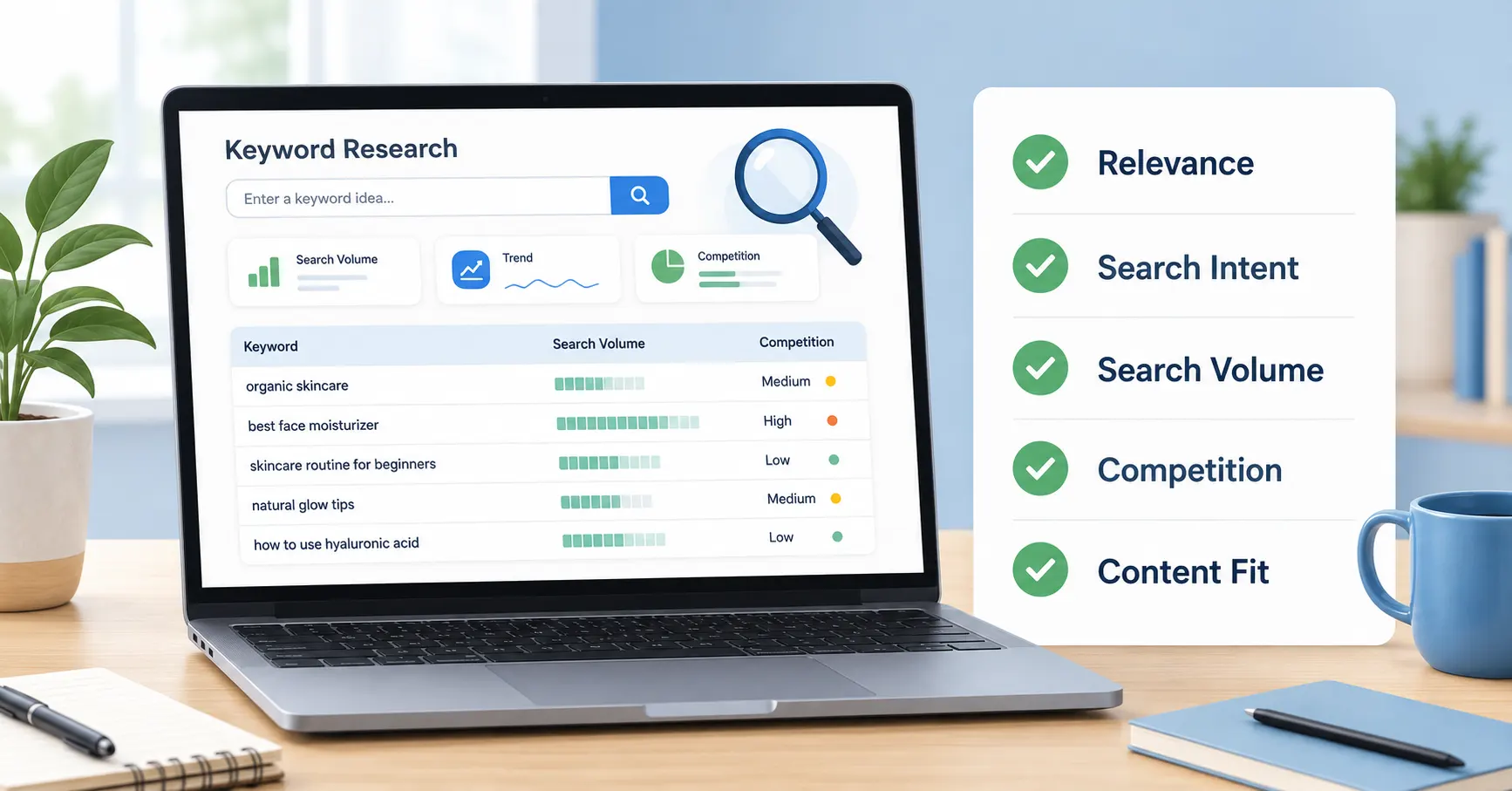
A keyword research tool can provide additional ideas and estimated data.
Tools such as Ubersuggest may show:
- Estimated monthly search volume
- SEO difficulty
- Paid competition
- Estimated cost per click
- Related keywords
- Questions
- Keyword variations
Begin by entering one of your seed topics.
For example, entering “how to do keyword research” may reveal related searches such as:
- How to do keyword research for beginners
- How to do keyword research for a blog post
- How to do keyword research for a website
- How to do keyword research for free
- How to do keyword research with free tools
You can also explore Google Keyword Planner to discover related keyword ideas and view estimated monthly search activity. Although it is primarily designed for Google Ads, its keyword suggestions can provide another useful source of ideas when planning website content.
Do not assume the keyword with the highest search volume is automatically the best choice.
Keyword tools provide estimates rather than guarantees. Use the data as guidance alongside your understanding of your audience and website.
The best keyword is usually one that combines relevance, clear search intent and realistic competition.
Step 4: Understand Search Volume
Search volume estimates how many times a keyword is searched during an average month.
A higher number can indicate greater demand, but higher-volume keywords are often more competitive.
A lower-volume keyword should not be rejected automatically.
Suppose a keyword receives only a small number of monthly searches but precisely matches a problem faced by your audience.
A detailed article targeting that phrase may also appear for several related searches.
One article can attract traffic from more than one exact keyword.
When reviewing search volume, ask:
- Is this something my audience genuinely searches for?
- Is the subject closely related to my website?
- Can I create a complete and helpful answer?
- Could the article support other important pages?
- Does the search suggest a useful next step?
For a growing website, a collection of relevant lower-volume articles can become a steady source of targeted traffic.
Step 5: Check Keyword Difficulty
Keyword difficulty is an estimate of how challenging it may be to rank for a search.
A higher score generally suggests that established websites already compete strongly for the keyword.
However, difficulty scores should not be treated as exact measurements. Different tools calculate them differently.
Use the score as a warning sign rather than a final decision.
When a keyword appears highly competitive, look for a more focused variation.
Instead of targeting:
Email marketing
You might target:
How to start an email list for a new blog
Instead of:
Website traffic
You might target:
How to get the first visitors to a new website
These narrower phrases allow you to address a clearer problem.
They also make it easier to write an article that stays focused instead of trying to cover an enormous subject in one post.
How to Find Low-Competition Keywords
Low-competition keywords are phrases that may be easier for a smaller or newer website to target.
They are often longer, more specific and focused on a particular problem.
To find them:
- Start with a broad seed topic
- Look for specific questions and long-tail keywords
- Compare keyword difficulty estimates
- Review the websites already ranking
- Avoid search results dominated entirely by major brands
- Look for subjects where current articles are outdated, unclear or incomplete
A low difficulty score does not guarantee a ranking.
However, combining lower competition with clear search intent and useful content can give a growing website a more realistic opportunity.
Step 6: Identify the Search Intent
Search intent is the reason behind a search.
Identifying the broad category is only the beginning. This complete guide explains how to determine search intent by reviewing the query, current results, expected format and reader’s next question.
Before choosing a keyword, work out what the person expects to find.
Most searches fall into one of several broad categories.
Informational intent
The person wants to learn something.
Examples include:
- What is affiliate marketing?
- How does SEO work?
- How to do keyword research
Commercial research intent
The person is comparing products, services or approaches before making a decision.
Examples include:
- Best keyword research tools for beginners
- Ubersuggest versus Semrush
- Best website hosting for a small blog
Transactional intent
The person is ready to take action, register or purchase.
Examples include:
- Buy website hosting
- Join an affiliate marketing course
- Start an email marketing account
Navigational intent
The person wants to reach a particular website, brand or page.
Examples include:
- Ubersuggest login
- Google Search Console
- Pro Club members area
Your article must match the search intent.
A person searching “how to do keyword research” is probably looking for instructions, examples and a clear process. They are unlikely to be satisfied by a page that mainly promotes a keyword tool.
Help them understand the process first.
You can then recommend an appropriate resource as a natural next step.
Once you have selected your keyword and understood the search intent, the next step is turning it into useful content. This guide explains how to write a blog post for beginners using a simple 11-step process.

Step 7: Examine the Current Search Results
Search the keyword in Google and look at the pages currently appearing.
You are not copying these pages.
You are trying to understand what type of content Google is showing for the search.
Look for patterns such as:
- Beginner guides
- Step-by-step tutorials
- Tool comparison pages
- Videos
- Checklists
- Product pages
- Short definitions
- Detailed pillar articles
Review the titles and consider the main questions those pages answer.
You should also look for opportunities to make your article more helpful.
Perhaps the existing results assume too much experience, use confusing terminology or fail to provide practical examples. Your article could explain the topic in a clearer and more beginner-friendly way.
Avoid choosing a keyword when the results show a completely different intent from the article you plan to create.
Step 8: Choose One Focus Keyword
Each post should have one main focus keyword. After choosing it, use the on-page SEO checklist to place it naturally in the important page elements.
The focus keyword gives the article a clear direction. It can be used naturally in important places such as:
- The SEO title
- The H1 heading
- The URL
- The introduction
- At least one subheading
- The meta description
- The image alt text where relevant
- The main body of the article
This article focuses on how to do keyword research.
Related phrases such as “keyword research for beginners” and “how to do keyword research for a blog post” support the topic without changing its main purpose.
Do not force the exact keyword into every paragraph. Use natural variations and write for the reader.
Step 9: Group Related Keywords Together
You usually do not need to create a separate article for every slightly different keyword.
For example, these searches can be answered within one complete guide:
- How to do keyword research
- How to do keyword research for beginners
- How to do keyword research for a website
- How to do keyword research for a blog post
They share almost the same search intent.
Grouping them into one strong article prevents you from publishing multiple thin posts that compete with one another.
However, a phrase such as “best free keyword research tools” may deserve its own article because the searcher wants a comparison of tools rather than a general explanation of the process.
The deciding factor is not whether the wording is different. It is whether the searcher expects a different answer.
Step 10: Create a Simple Keyword Plan
You do not need an enormous spreadsheet to begin.
A basic keyword plan can include:
- Focus keyword
- Supporting keywords
- Search intent
- Proposed article title
- Article category
- Pillar page being supported
- Status
- Publication date
- Internal links to add
Start with a manageable group of articles.
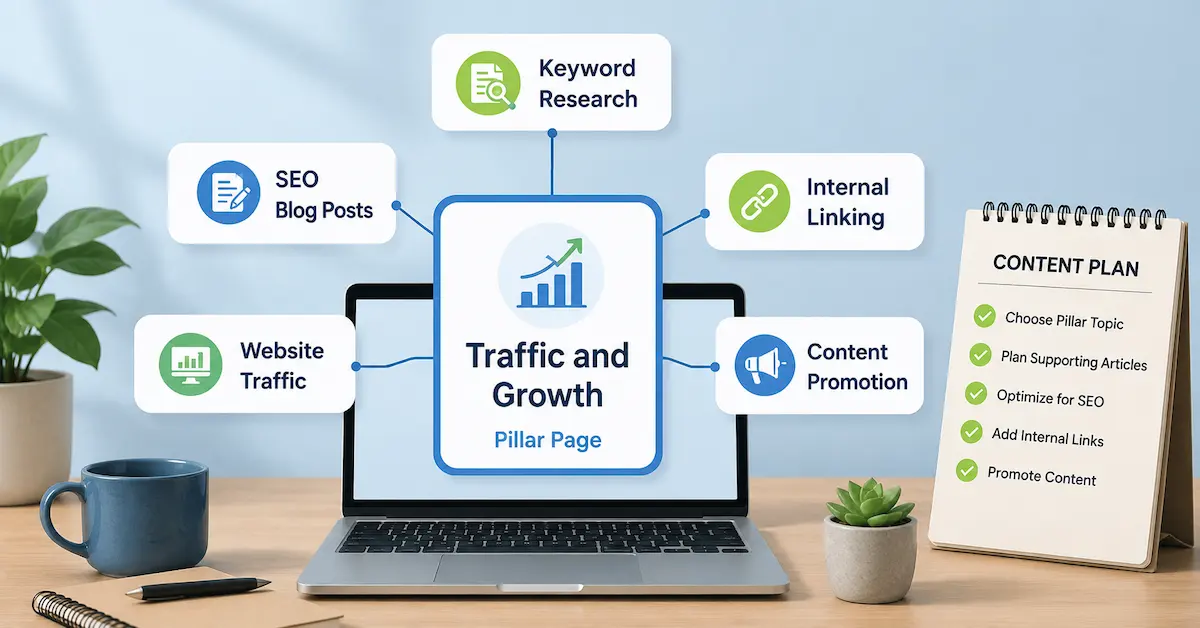
For a traffic and growth topic cluster, you might plan content around:
- How to do keyword research
- How to increase website traffic
- How to write SEO-friendly blog posts
- How to use internal links
- How to promote a new blog post
- How long SEO takes to produce traffic
Each supporting post can link back to the main Traffic and Growth pillar.
The pillar can also link to the supporting posts, creating a clear structure for both visitors and search engines.
Common Keyword Research Mistakes
Beginners often make keyword research more complicated than it needs to be.
Common mistakes include:
Choosing keywords only because they have high search volume
A high-volume keyword may be too broad, too competitive or poorly matched to your website.
Ignoring search intent
An article will struggle when it provides a tutorial but searchers mainly want a product or comparison page.
Targeting unrelated keywords
Traffic is only useful when it attracts people who are genuinely interested in your website’s subject.
Repeating the exact phrase too often
Keyword repetition can make an article awkward and difficult to read. Use the focus phrase naturally alongside relevant variations.
Publishing several posts with the same purpose
Multiple similar articles can compete with one another. Combine closely related keywords when they share the same intent.
Expecting immediate results
Keyword research improves your direction, but it does not guarantee instant rankings. This guide to how blog SEO helps posts get traffic explains how research, content and internal links work together over time. Content quality, website authority, internal linking, competition and time can all affect performance.
A Simple Beginner Keyword Checklist
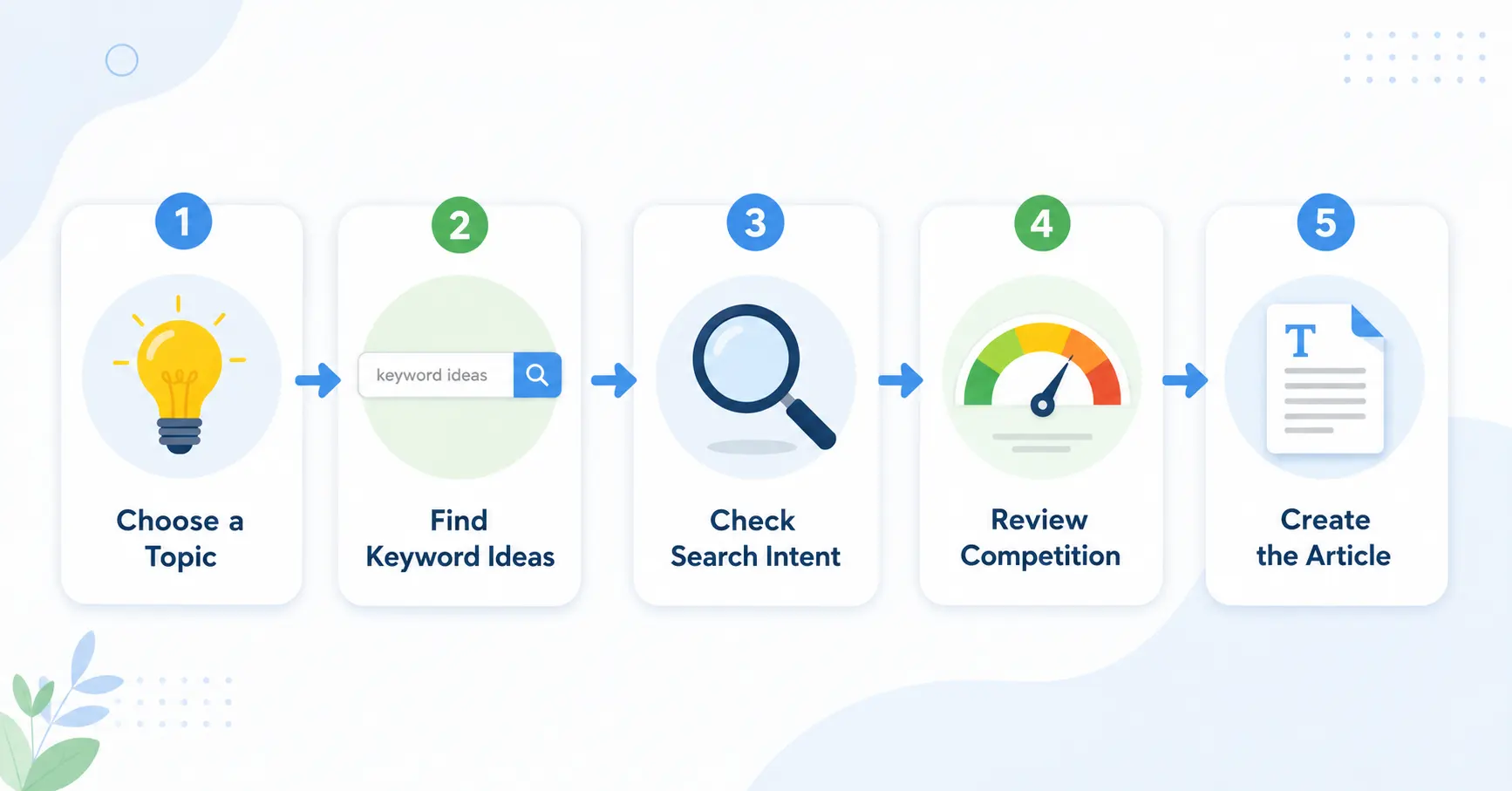
Good beginner keyword research starts with relevance rather than search volume.
Before choosing a keyword, ask:
- Is it closely related to my website?
- Does it address a real question or problem?
- Do I understand what the searcher wants?
- Can I provide a complete and useful answer?
- Is the competition realistic for my website?
- Does it support one of my main pillar topics?
- Can I link it to other relevant articles?
- Is there a sensible next step for the reader?
You do not need a perfect keyword.
You need a relevant subject, a clear search intent and a useful article that answers the question better than a vague or rushed post.
These methods can help you uncover useful content keyword ideas for future supporting posts.
Your 30-Minute Keyword Research Action Plan
Spend ten minutes listing three broad topics related to your website.
Spend another ten minutes turning each topic into specific questions.
Use the final ten minutes to check those questions in a keyword tool and Google search.
Choose one keyword that:
- Matches your audience
- Has a clear search intent
- Supports one of your pillar pages
- Is specific enough to answer properly
- Has realistic competition
You will finish with one useful article idea rather than a confusing list of hundreds of keywords.
Take the Next Step With CB Profit Club
Learning keyword research is easier when you have a clear process to follow.
CB Profit Club provides additional training, tools and guidance to help you choose content topics, improve your online business and turn what you learn into practical action.
Rather than trying to work everything out alone, you can follow structured guidance and continue building your website one step at a time.
Learn more about CB Profit Club and see what is included.

Frequently Asked Questions
What is the best keyword research method for beginners?
Start with a broad topic related to your website, turn it into specific questions and use a keyword research tool to find related searches. Then compare relevance, search intent, estimated volume and competition before choosing one main keyword.
Can I do keyword research for free?
Yes. You can use Google search suggestions, related searches, Google Search Console and limited free versions of keyword tools. Paid tools may provide more data, but they are not essential when you are beginning.
How many keywords should one blog post target?
Choose one main focus keyword and several closely related supporting phrases. Avoid targeting several unrelated subjects in the same article. The post should have one clear purpose.
Are low-volume keywords worth targeting?
They can be. A low-volume keyword may attract fewer searches, but the visitors can be highly relevant. An article may also rank for several related phrases rather than only the exact focus keyword.
How often should keyword research be done?
Do keyword research when planning new content and review your keyword plan periodically. You can also use Search Console data to find existing pages that are receiving impressions and may benefit from updates.
How long does it take for a keyword-focused article to get traffic?
There is no fixed timeframe. A new article may take weeks or months to gain visibility, particularly on a new website. Competition, content quality, internal links, backlinks and website authority can all influence the result.
Final Thoughts
Keyword research helps you replace guesswork with a clearer content plan. Begin with the main subjects covered by your website, identify the questions your audience is asking and then evaluate the relevance, intent and competition behind each keyword.
You do not need to target the largest or most competitive phrase in your industry. A focused article that answers a specific beginner question can be more useful—and more realistic for a growing website—than a broad post that tries to cover everything.
Choose one suitable keyword, create the most helpful answer you can and connect the article to the wider topic through sensible internal links. Then use this process for writing blog posts that get traffic.
After choosing your keywords, use this guide to turn them into a practical website traffic growth plan.
What’s next:
Continue learning how keyword research fits into your overall strategy in the Traffic and Growth for Beginners guide.
Continue Your Online Business Journey
Explore more resources to help you build and grow your online business.
Recommended Reading
New Here?
Start with the beginner roadmap and learn the fundamentals of affiliate marketing and online business.
Start HereReady For The Next Step?
Discover the complete system I use to build and grow an online business.
Join Profit Club
