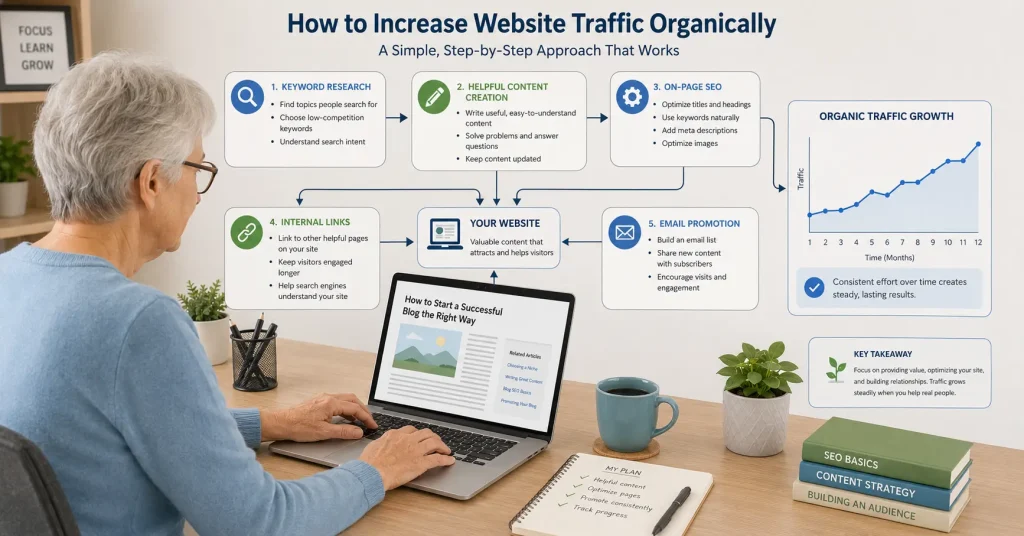

How to Increase Website Traffic Organically: 9 Proven Steps for Beginners
Learning how to increase website traffic can feel confusing when your site is new.
You may publish a few articles, share them once, check your statistics and wonder why hardly anyone is visiting. This is a normal stage of building a website. Traffic rarely appears simply because a page has been published.
The good news is that beginners do not need expensive advertising, complicated funnels or a presence on every social platform.
You need a clear topic, useful content, basic SEO, sensible promotion and enough time to learn what works.
This guide focuses on practical ways to increase website traffic organically. Organic traffic is earned through search engines, helpful content, internal links, referrals, email and unpaid promotion rather than buying every visit.
It provides a simple introduction to website traffic for beginners who want to attract relevant visitors without relying entirely on paid advertising.
For a broader explanation of how these channels work together, read the Traffic and Growth guide.
Affiliate disclosure: This article may contain affiliate links. If you purchase through one of these links, I may earn a commission at no additional cost to you. I only recommend resources that I believe may be useful for beginners.
What Is Organic Website Traffic?
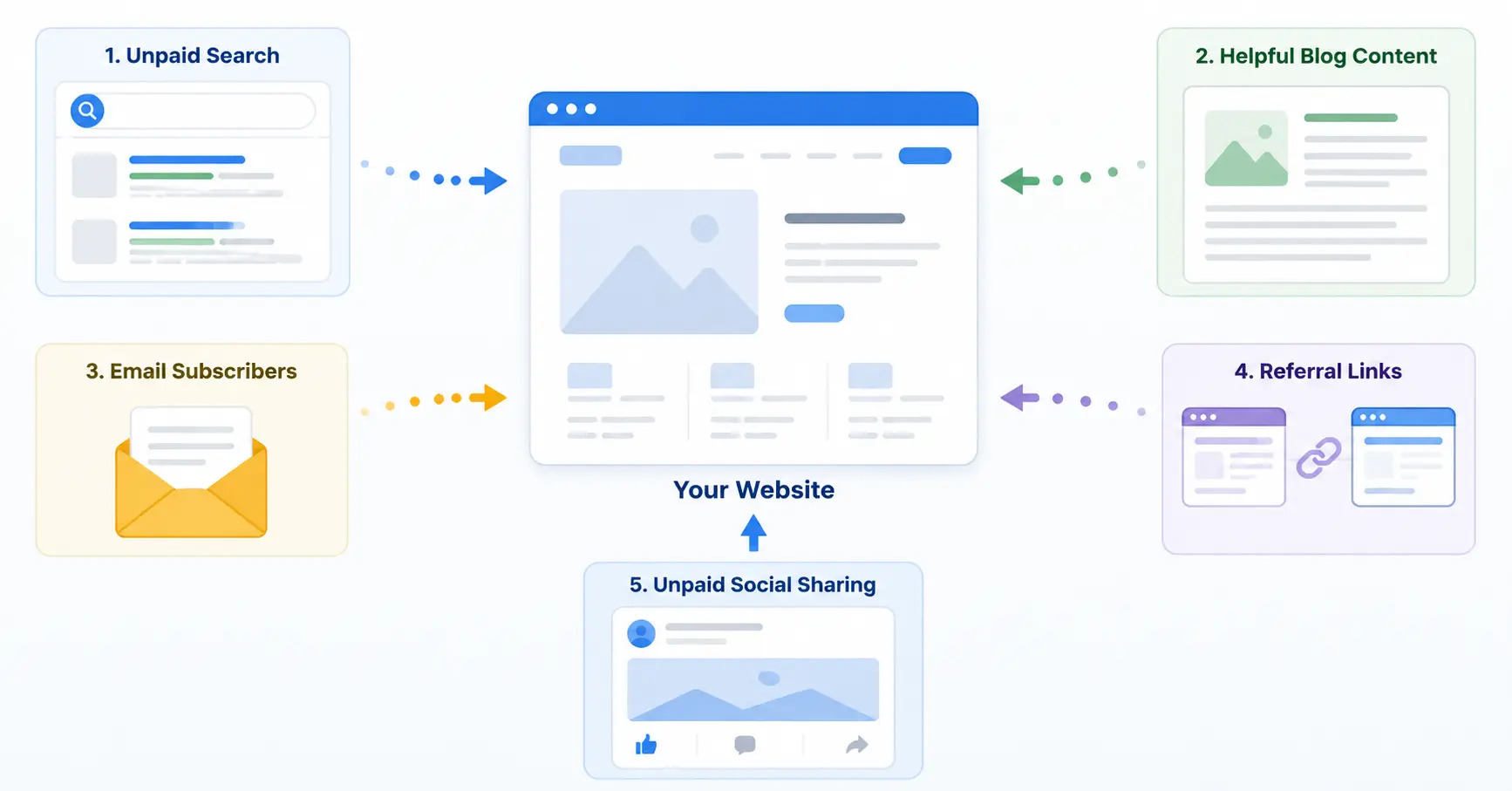
Organic website traffic usually refers to visitors who find your pages through unpaid search results.
A wider organic growth plan can also include unpaid visits from social posts, email subscribers, referrals and online communities.
These different website traffic sources can work together. Someone might first discover your article through Google, return through an email and later visit another page using an internal link.
The aim is not to attract the largest possible number of random visitors. You want targeted website visitors who are interested in your topic and likely to benefit from your content.
Before choosing a traffic method, ask:
- Who am I trying to help?
- What question are they asking?
- Which page gives them the clearest answer?
- What useful step should they take next?
These questions keep your traffic strategy focused on people rather than numbers alone.
1. Choose One Clear Audience and Topic
Traffic becomes easier to build when your website has a clear purpose.
A site covering affiliate marketing, gardening, travel, recipes and personal finance at the same time may confuse readers and search engines. A beginner site is usually stronger when it starts with one audience and a small number of connected topics.
For example, a website helping online business beginners could cover starting a business, affiliate marketing, keyword research, beginner SEO, content creation and website traffic. These subjects connect naturally, allowing each article to answer one question while supporting a wider learning path.
Write a simple audience statement such as:
I help beginners understand how to build and grow an online business using clear, affordable and practical steps.
Use that statement when choosing every new article.
This clear focus is one of the simplest foundations for anyone learning how to increase website traffic organically.
2. Find Specific Keywords Beginners Can Compete For
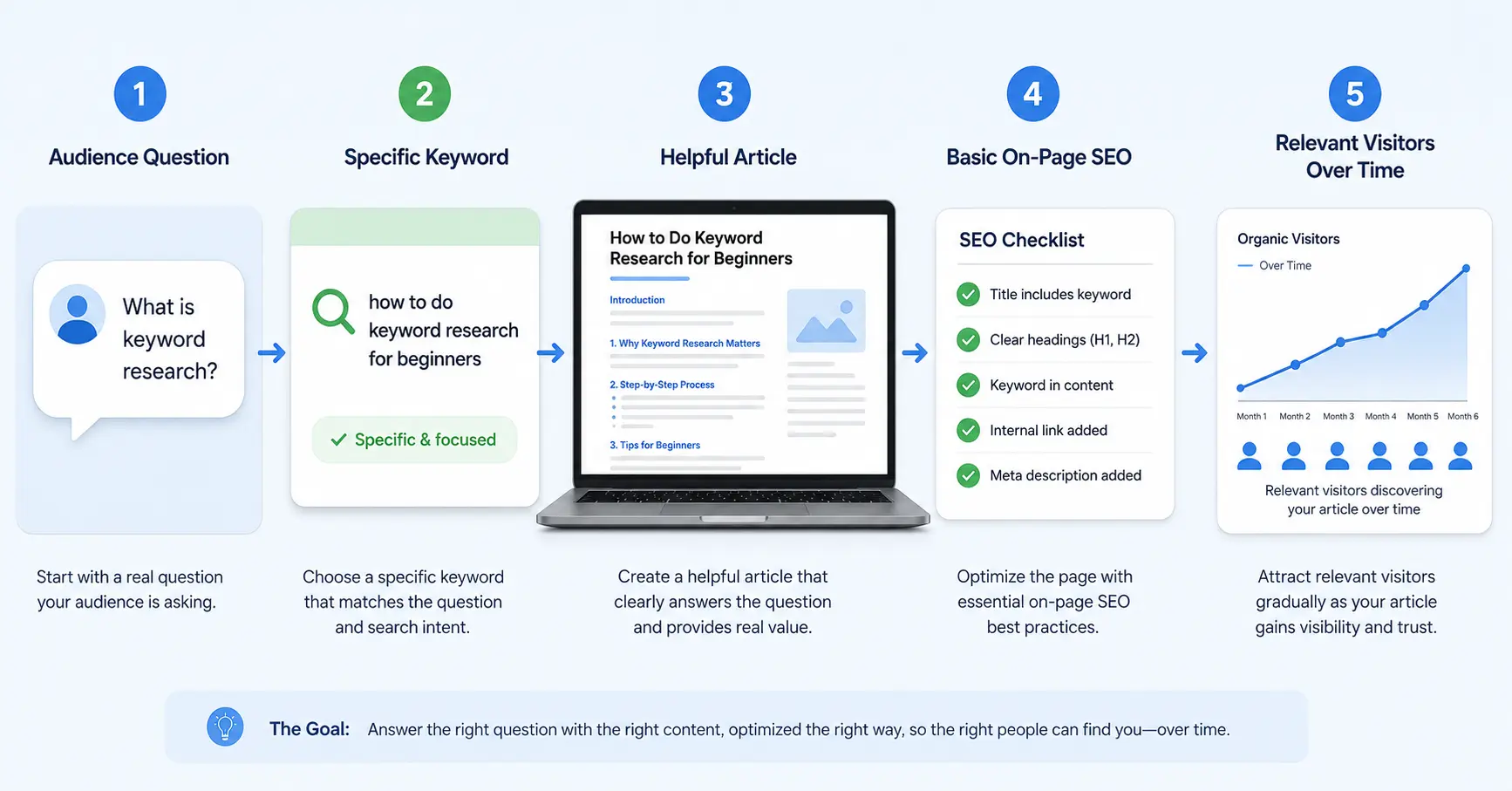
Keyword research helps you understand the words people use when searching.
Broad phrases such as “traffic” or “marketing” may be difficult to target because they can mean many things. More specific searches reveal a clearer problem.
Examples include:
- how to increase website traffic organically;
- how to get traffic to a new website;
- how to increase website traffic using SEO;
- how to promote a blog post;
- how to get website traffic for free; and
- why a new website is not getting traffic.
A specific keyword makes it easier to plan the title, introduction, headings and examples.
Do not select a phrase only because it has a high search volume.
Check whether it matches your audience, whether you can answer it properly and whether the existing search results are much stronger than your site.
Use one focus keyword for the page and add related phrases naturally. Do not force every variation into the article.
For a step-by-step process, see How to Do Keyword Research.
3. Create Content That Solves One Real Problem
Content is the main engine of long-term website traffic.
Each article should help a reader understand something, solve a problem, make a decision or complete a task. It should not exist merely to add another page to your website.
A useful beginner article gives a clear answer early, explains the topic simply, provides practical steps, uses descriptive headings, links to related information and offers a sensible next action.
Try to make the article clearer or easier to follow than the pages already available. That does not always mean making it longer. A well-organised guide can be more helpful than a longer, repetitive post.
Content marketing for beginners works best when articles are planned as a connected series. One useful post can answer an immediate question, while internal links help the reader discover the next relevant guide.
This approach can gradually build blog traffic because every new article strengthens the wider collection of information on your website.
Plan connected articles rather than random topics. The Content Marketing Strategy Guide explains how to organise content around your audience, pillars and publishing schedule.
Google’s SEO Starter Guide is also a useful external reference for creating clear, helpful and search-friendly pages.
4. Complete Basic On-Page SEO Before Publishing
On-page SEO helps readers and search engines understand the subject of a page.
You do not need to make it complicated. Before publishing, check that the article has:
- one clear H1 title;
- a short descriptive URL;
- the focus keyword in the title and introduction;
- useful H2 and H3 headings;
- a clear meta description;
- descriptive image file names and alt text;
- internal links to related pages;
- at least one trustworthy external source where relevant;
- a readable mobile layout; and
- a natural call to action.
SEO for website traffic is not about adding the same keyword everywhere. It is about making the page easy to understand, navigate and use.
Avoid repeating the focus keyword in every paragraph. Use normal language and related terms where they make sense.
Use the full On-Page SEO Checklist before each post goes live. For a wider explanation, read SEO for Beginners.
5. Build Internal Links Between Related Pages
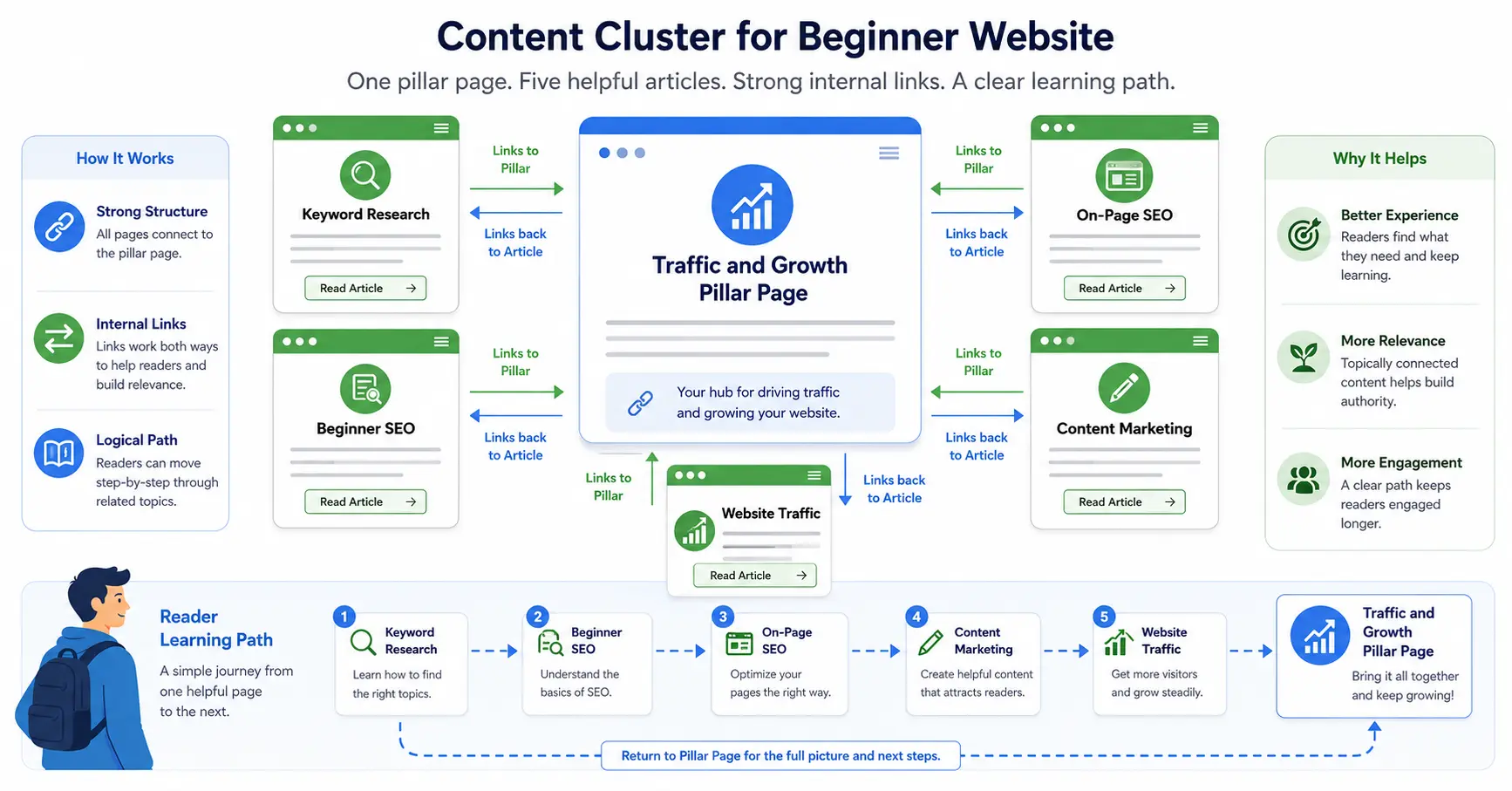
Internal links connect one page on your website to another.
They help readers continue learning and help search engines understand how your content is organised. They can also direct attention towards your most important pillar pages.
For example, an article about increasing website traffic could link to guides about keyword research, SEO, on-page optimisation and content marketing. Those guides should also link back to the main Traffic and Growth pillar.
Use descriptive anchor text. “Read the beginner keyword research guide” tells the reader more than “click here.”
Add internal links when you publish a new article, but also return to older posts and link them to the new page. This gives the article more ways to be discovered within your site.
6. Promote Every Article More Than Once
Publishing is only the first part of the job.
To increase website traffic organically, promotion needs to continue after the article has been published.
Choose one or two promotion methods you can maintain. You might:
- email the article to subscribers;
- share one useful lesson on Facebook or LinkedIn;
- create a Pinterest image;
- record a short video based on one section;
- answer a relevant question in a community; or
- link to the article from an older post.
These free traffic methods can help an article receive its first visitors while it begins appearing in unpaid search results.
You can increase website traffic for free, but you normally need to invest time in creating, sharing and improving your content.
Avoid dropping links into groups without contributing anything useful. Explain the idea first and share the article only when it genuinely helps answer the question.
7. Start Building an Email List Early
Search and social platforms can introduce people to your website, but an email list helps you reach them again.
You do not need thousands of visitors before starting. Even a small amount of relevant traffic can gradually build a useful audience.
Offer a simple resource connected to your content, such as a website traffic checklist, beginner SEO worksheet or 30-day content plan. Then send helpful emails that direct subscribers to useful articles.
Email can also encourage previous visitors to return to your website, read new content and explore related pages.
8. Update Older Content Instead of Only Publishing More
An older article may already have impressions, links or a small amount of traffic. Improving it can sometimes be more useful than immediately creating another post.
Review older pages and look for:
- outdated information;
- weak introductions;
- missing internal links;
- unclear headings;
- poor image alt text;
- unanswered questions;
- titles that receive impressions but few clicks; and
- calls to action that no longer fit.
Add useful examples, improve the structure and link to newer related content. These updates can improve website traffic by making the article more complete and useful.
Record the date you reviewed the page so updates become part of your normal publishing routine.
9. Measure a Small Number of Useful Results
Beginners can become distracted by checking traffic every day.
Instead, review a few useful measurements over a longer period:
- search impressions;
- search clicks;
- pages receiving organic visits;
- keywords beginning to appear;
- internal link clicks;
- email sign-ups; and
- pages that lead visitors to another useful step.
Google Search Console can show how pages appear in search, while an analytics tool can show what visitors do after arriving.
When you measure website traffic, focus on gradual changes rather than individual daily results. Website traffic growth often happens slowly as more useful pages are indexed, discovered and linked together.
Do not judge a new post after a few days. Look for gradual signs of progress and use the information to decide what to improve next.
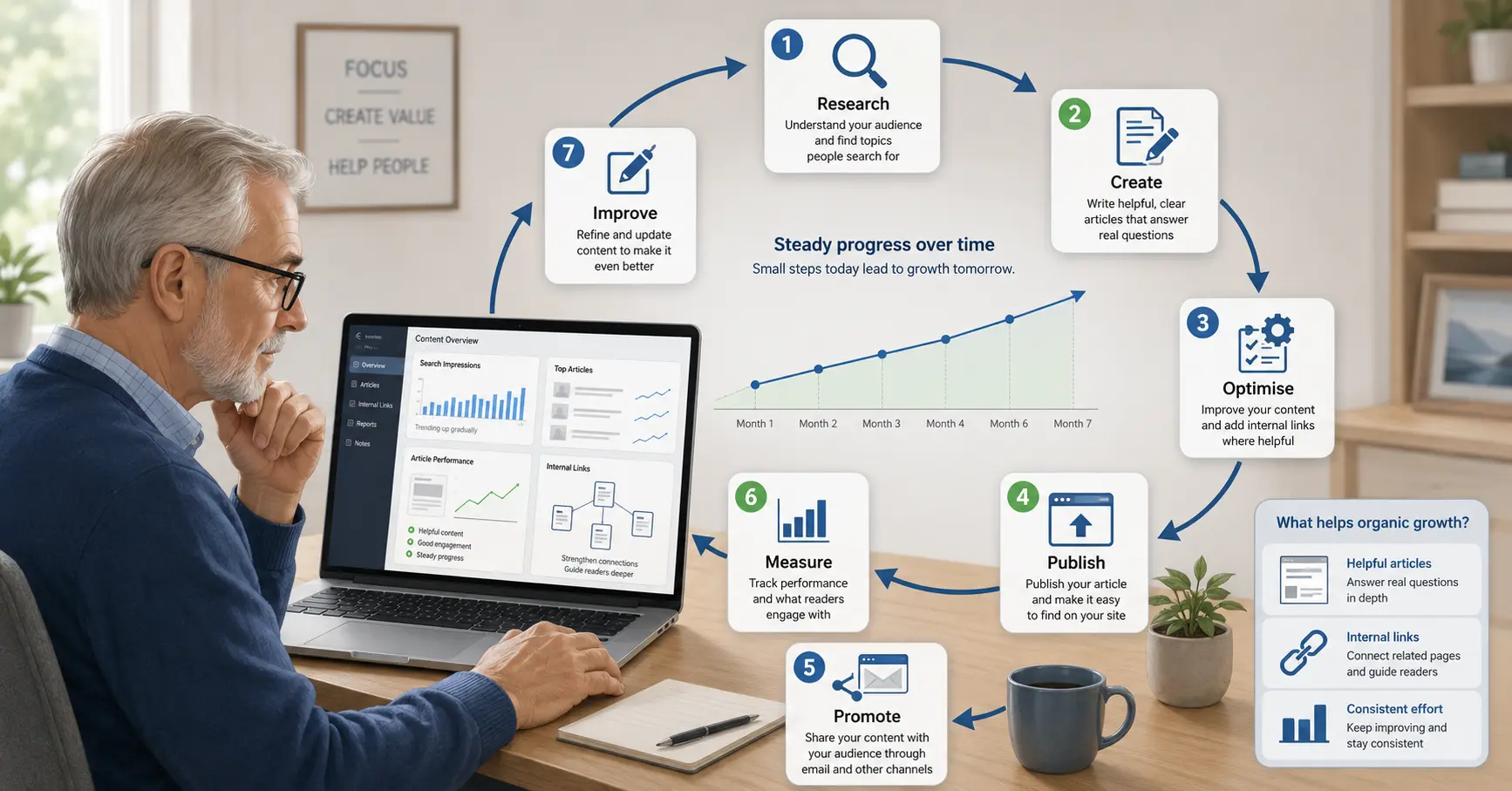
A Simple 30-Day Website Traffic Plan
Keep your first month manageable.
This simple monthly routine shows how to increase website traffic organically without trying to master every available traffic channel at once.
Week 1: Build the Foundation
Choose your audience, topic and focus keyword. Check that the site can be indexed and outline the article around the reader’s main question.
Week 2: Publish One Strong Article
Add clear headings, images, internal links, a meta description and a relevant next step. Complete your on-page SEO check before publishing.
Week 3: Promote and Connect It
Share the article through one or two channels. Link to it from older posts and back to the relevant pillar.
Week 4: Review and Improve
Check indexing and early search impressions. Improve weak sections and plan the next supporting article.
Then repeat the cycle:
Research → Create → Optimise → Publish → Promote → Measure → Improve
Consistency matters more than trying every traffic method at once.
Want More Guidance With Traffic and Online Business?
Building traffic is easier when you have a clear learning path and practical steps to follow.
Explore CB Profit Club to see the training, tools and support available for beginners building an online business.
Choose resources that match your goals, budget and experience. No course or traffic method can guarantee results, but structured guidance can clarify what to work on next.
Common Website Traffic Mistakes to Avoid
Many beginners slow their progress by:
- publishing unrelated articles;
- targeting keywords that are too broad;
- writing for search engines instead of readers;
- ignoring internal links;
- promoting once and stopping;
- trying to use every social platform;
- failing to build an email list;
- checking statistics too frequently; or
- giving up before the website has enough useful content.
Don’t avoid including internal linking. Internal links can help visitors discover more of your useful content and spend more time on your site. Learn how to connect related blog posts as part of your organic traffic strategy.

Frequently Asked Questions
How long does it take to increase website traffic?
There is no fixed timeframe. A new website may take several months to build consistent organic traffic. The timing depends on competition, content quality, website authority, technical setup, promotion and how regularly you publish and improve useful pages.
What is the best free traffic source for beginners?
Organic search is a strong long-term option because it reaches people who are already looking for an answer. Email and one suitable social platform can support it. The best starting source is one that fits your skills and can be used consistently.
How many blog posts do I need before traffic grows?
There is no required number. Focus on building a connected collection of useful articles around one subject. Ten well-planned posts with clear keywords and internal links may be more valuable than many unrelated posts.
Can I increase website traffic without social media?
Yes. A website can grow through search traffic, email, referrals, guest contributions and internal links. Social media can help promote content, but you do not need to be active on every platform.
Should I pay for website traffic?
Paid advertising can be useful when you understand your audience, offer and conversion process. Beginners should be cautious because costs can rise quickly. Build a useful website and test your message before relying heavily on paid traffic.
Can I increase website traffic for free?
Yes, but free traffic still requires time and effort. SEO, helpful content, internal links, email and unpaid promotion can attract visitors without paying for every click. Results generally build gradually rather than appearing immediately.
Final Thoughts
Learning how to increase website traffic organically is not about discovering one secret trick.
It is about connecting several simple actions:
- choose a clear audience;
- research specific keywords;
- create genuinely useful content;
- complete basic on-page SEO;
- connect related pages;
- promote each article;
- build an email list;
- update older content; and
- measure gradual progress.
Start with one traffic method and one useful article. Then repeat the process.
Once you start getting traffic, one way to convert visitors into subscribers is through webinar automation and an evergreen registration funnel.
For the complete overview of SEO, content, social media, email and other beginner traffic methods, continue with the Traffic and Growth pillar.
Explore more resources to help you build and grow your online business. Start with the beginner roadmap and learn the fundamentals of affiliate marketing and online business. Discover the complete system I use to build and grow an online business.
Continue Your Online Business Journey
Recommended Reading
New Here?
Ready For The Next Step?