
How to Choose the Right Affiliate Program: A Beginner’s Guide
Choosing an affiliate program can feel exciting.
You see a popular product, an attractive commission, and a quick signup form.
It looks like an easy opportunity.
Yet a program that looks good on the surface may not suit your audience, content, or goals.
The right program gives you something useful to recommend. It should also provide reliable tracking, fair payment structure, clear rules, and a good customer experience.
This guide explains how to choose an affiliate program without chasing hype. If you are still setting up the wider process, begin with how to start affiliate marketing step by step .
You will learn what to check, which warning signs to avoid, and how to compare your options.
Learning how to choose an affiliate program can help you avoid poor products, unfair terms, and wasted content.
For a complete introduction, read the Affiliate Marketing for Beginners pillar guide.
Affiliate disclosure: This article may contain affiliate links. If you purchase through one of these links, I may earn a commission at no additional cost to you. I only recommend resources that I believe may be useful for beginners.
What Is an Affiliate Program?
An affiliate program is an agreement between a business and a promoter.
- You join the program and receive a unique tracking link.
- You share that link through helpful content, such as tutorials, reviews, comparisons, emails, or resource pages.
When someone clicks your link and completes a qualifying action, you may then earn a commission.
That action could be a purchase, trial, lead, subscription, or app installation.
The process sounds simple. However, programs use different commission rates, cookie periods, payment methods, approval rules, and promotional terms.
That is why careful selection matters.
Some programs are managed directly by the merchant, while others operate through a larger platform. This guide explains how an affiliate network works and how it differs from a direct program.
Why Choosing the Right Program Matters
A poor program can waste your time and weaken your audience’s trust.
Understanding how to choose an affiliate program means looking beyond the advertised commission rate.
You might create useful content and send qualified visitors to a merchant, but…
You could still earn little because the sales page converts poorly, the tracking period is short, or the product creates many refunds.
A suitable program works with your content.
- The product matches your audience.
- The offer solves a real problem.
- The merchant treats customers well.
- The program tracks referrals correctly and pays commissions as promised.
You do not need dozens of affiliate programs for beginners.
A few carefully chosen offers are usually easier to understand, promote, and improve.
1. Start With Your Audience
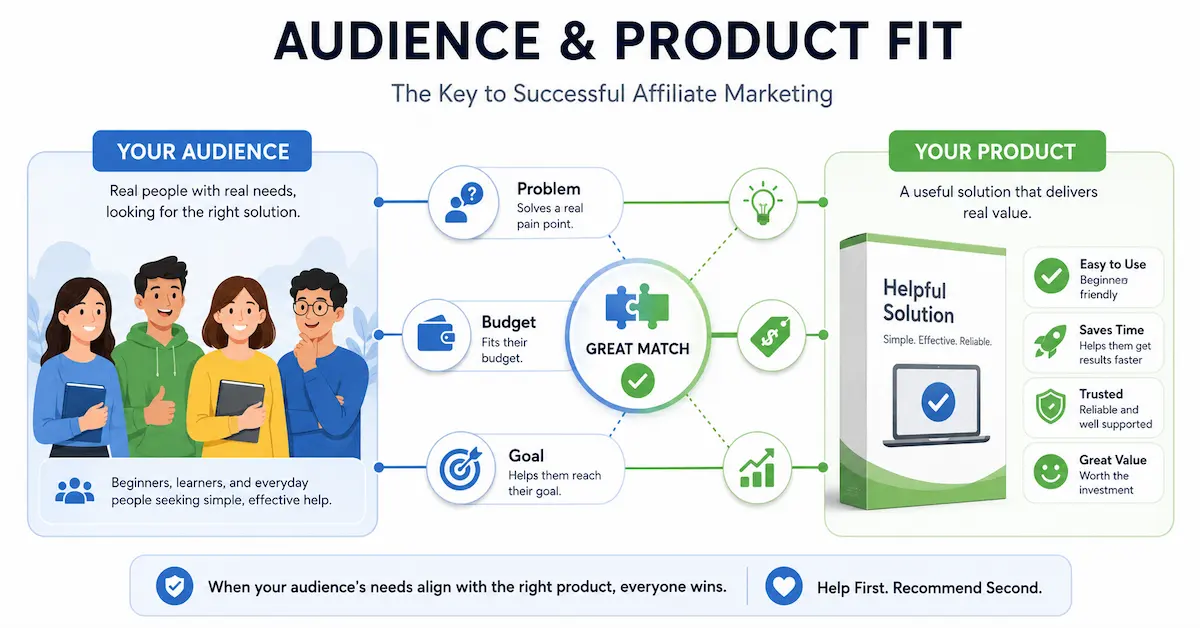
Do not begin by asking, “How much does this program pay?”
Ask, “Would this product genuinely help my audience?”
A program can offer a high commission and still be a bad fit.
If the product does not match the reader’s problem, your recommendation will feel forced.
Think about the people reading your content. If your market is not yet clear, compare these affiliate marketing niches for beginners before choosing products.
- What are they trying to achieve?
- What is stopping them?
- How much can they realistically spend?
- Do they need a simple tool, detailed training, or a low-cost starting point?
For example, someone building a first website may need affordable hosting, a domain, an email tool, and beginner training.
An expensive business platform may be unsuitable, even if it pays more.
Strong audience fit makes your recommendation useful and natural.
2. Check the Product and Company
Never promote a product only because other affiliates recommend it.
Research the product carefully. Use it yourself when practical.
When a free trial exists, test the signup process, main features, support, and cancellation steps.
Look beyond the company’s sales page.
Read independent reviews and search for repeated complaints.
Ask these questions:
- Does the product deliver what it promises?
- Is it suitable for beginners?
- Is the pricing clear?
- Does the company provide useful support?
- Are refunds and cancellations explained?
- Would I recommend it to someone I know?
Your reputation is worth more than one commission.
Some beginners may prefer a program that combines affiliate marketing training with a structured list-building and follow-up system. My guide to ClickBank Profit Club for beginners explains how this approach works, what is included and who it may suit.
Not every affiliate program deserves your trust. Before joining an unfamiliar offer, read our guide to whether affiliate marketing is a scam and learn how to distinguish an established affiliate program from misleading claims or questionable practices.
3. Understand the Commission Structure
Affiliate program commission rates matter, but they do not tell the whole story.
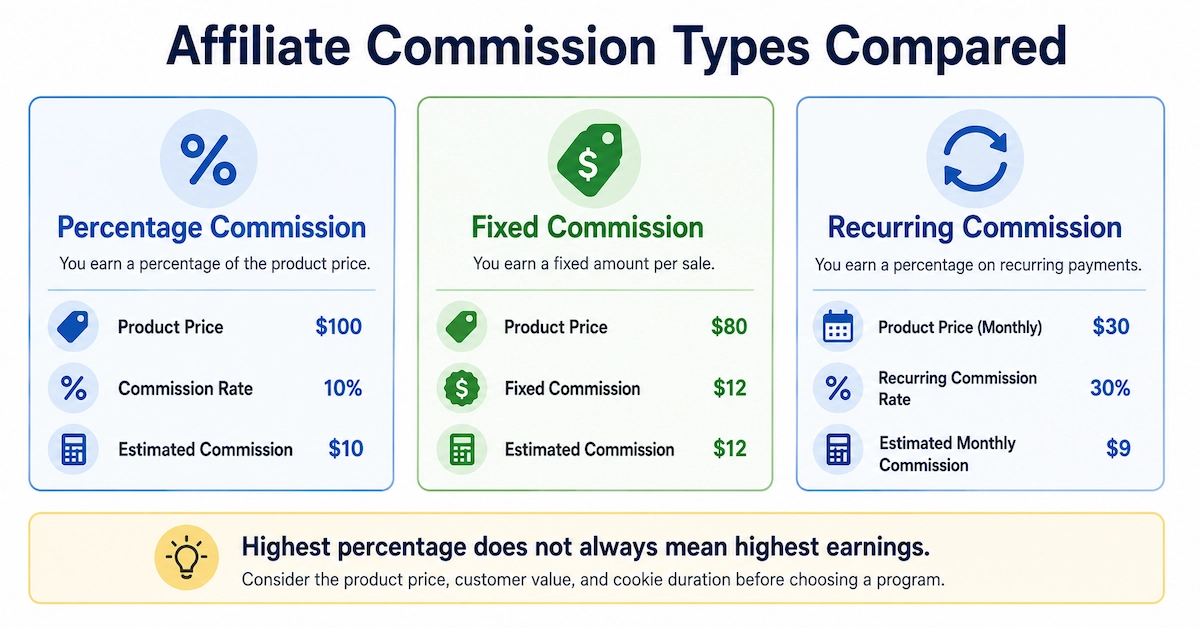
A 50% commission is not always better than a 10% commission.
You must also consider the product price, customer demand, conversion rate, refund rate, and payment model.
- A 50% commission on a $20 product pays $10.
- A 20% commission on a $100 product pays $20.
Common payment models include:
Percentage commissions: You earn a percentage of each sale.
Fixed commissions: You receive a set amount per sale or lead.
Recurring commissions: You continue earning while the customer remains subscribed.
Tiered commissions: Your rate rises after reaching a target.
Physical products often pay lower percentages but may have strong demand. Software and memberships may provide recurring commissions.
Recurring affiliate commissions can provide ongoing earnings while the customer remains subscribed.
Choose the structure that suits the product and buying process.
If these payment models are new to you, my guide to affiliate commission explains the seven main structures and what beginners should compare before choosing a program.
Do not choose high paying affiliate programs for beginners solely because the advertised rate looks impressive.
4. Review Cookie Duration and Tracking
An affiliate cookie helps connect a visitor’s action to your referral.
Affiliate cookie duration is the period during which you may receive credit after someone clicks your link.
A 30-day cookie usually means a qualifying purchase made within 30 days may earn a commission.
Longer tracking periods can help when buyers need time to compare products.
However, check the full attribution policy.
- Some programs credit the last affiliate link clicked.
- A later click from another website or affiliate may replace your referral.
Find out whether browser changes, different devices, coupon sites, or return visits affect tracking.
A longer cookie duration is helpful, but clear and reliable attribution is just as important.
These program details are easier to compare once you understand what affiliate links are and how attribution works.
5. Study the Payment Terms
A commission only has value when the program pays it reliably.
Check the following before joining:
- Minimum payout threshold
- Payment schedule
- Available payment methods
- Supported countries and currencies
- Holding periods
- Refund deductions
- Tax or identity requirements
Some programs pay monthly.
Others delay payment for 30, 60, or 90 days while they allow for refunds or fraud checks.
A large minimum threshold can be difficult for beginners. You may wait months before receiving your first payment.
Check the affiliate program payout threshold so you know how much you must earn before receiving payment.
Always review the affiliate program payment terms before creating content or sending traffic to an offer
Choose terms that are clear and practical for your circumstances.

6. Examine the Sales Process
Your content can create clicks, but the merchant must convert those clicks into customers.
Visit and view the product page as a buyer.
- Does it explain the offer clearly?
- Does it load quickly?
- Is the price easy to find?
- Are the guarantee, renewal terms, and cancellation process explained?
- Will it encourage you to buy?
Poor sales pages can reduce conversions even when the product is good.
Also consider what happens after the sale.
Aggressive upsells, confusing billing, weak support, and difficult cancellations can create complaints.
You are not only recommending a product. You are sending your reader into the merchant’s customer experience.
7. Read the Program Rules
Every affiliate program has terms that control how you can promote its offers.
Clear affiliate program rules help you understand which promotional methods are allowed.
Read them before creating content.
Program rules may also specify how affiliate relationships should be disclosed. These affiliate disclosure examples provide a useful starting point, but always check the individual program requirements.
A program may restrict:
- Paid advertising
- Brand-name bidding
- Email marketing
- Coupon websites
- Social media promotion
- Link shortening
- Customer incentives
- Product images
- Claims about income or results
Breaking the rules can lead to rejected commissions or account closure.
Pay close attention to affiliate disclosure requirements.
Readers should understand when a link may earn you a commission.
Clear disclosure protects trust and may also be legally required.
The FTC’s affiliate disclosure guidance explains how affiliate relationships should be disclosed clearly so readers understand when a recommendation may earn you a commission.
Save a copy of the terms and check for updates regularly.
8. Look for Support and Useful Tools
Good programs help affiliates explain the product accurately.
They may provide product guides, approved images, demonstration videos, deep links, reporting dashboards, and an affiliate manager.
These materials can save time.
However, they should not replace your own experience and explanation.
Your audience needs honest advice, useful examples, and a clear reason why the product may help them.
Test the support channel with a genuine question.
A helpful response is a good sign. Silence or generic answers may signal future problems.
9. Check Reporting and Tracking
You need clear data to help you understand your results.
Reliable affiliate tracking helps ensure that your referrals and commissions are recorded correctly.
A useful dashboard should show:
- Affiliate link clicks
- Conversions
- Commission amounts
- Approval status
- Refunds
- Payment history
Custom tracking labels are also valuable.
They let you see whether a review, tutorial, email, comparison, or resource page produced a sale.
Be cautious when a program provides vague reports or no process for investigating missing commissions.
Reliable reporting helps you improve your content based on evidence.
10. Compare Programs Before Choosing
When learning how to choose an affiliate program, don’t join the first option you find.
Searches for the best affiliate programs for beginners often produce long lists. However, a popular program is not automatically the right program for your audience.
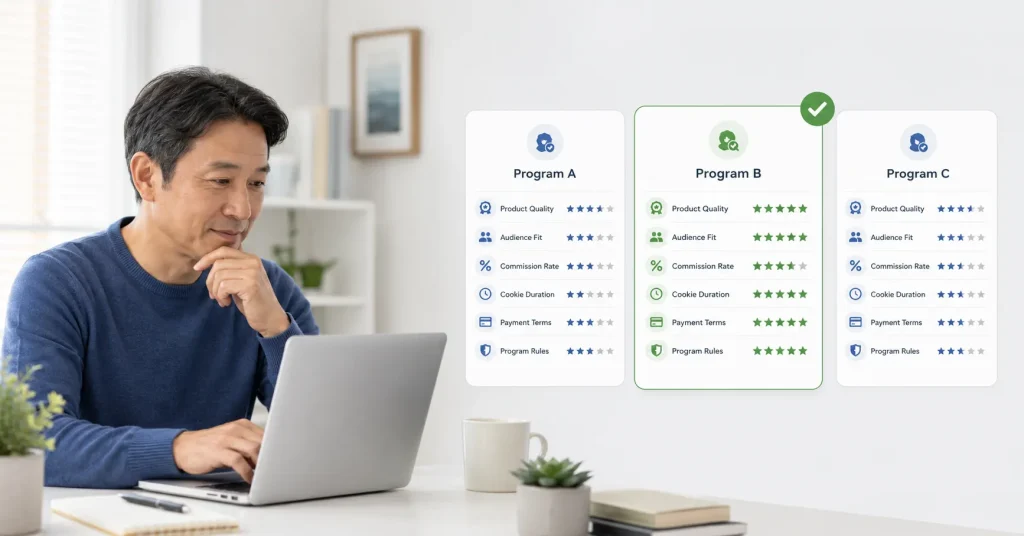
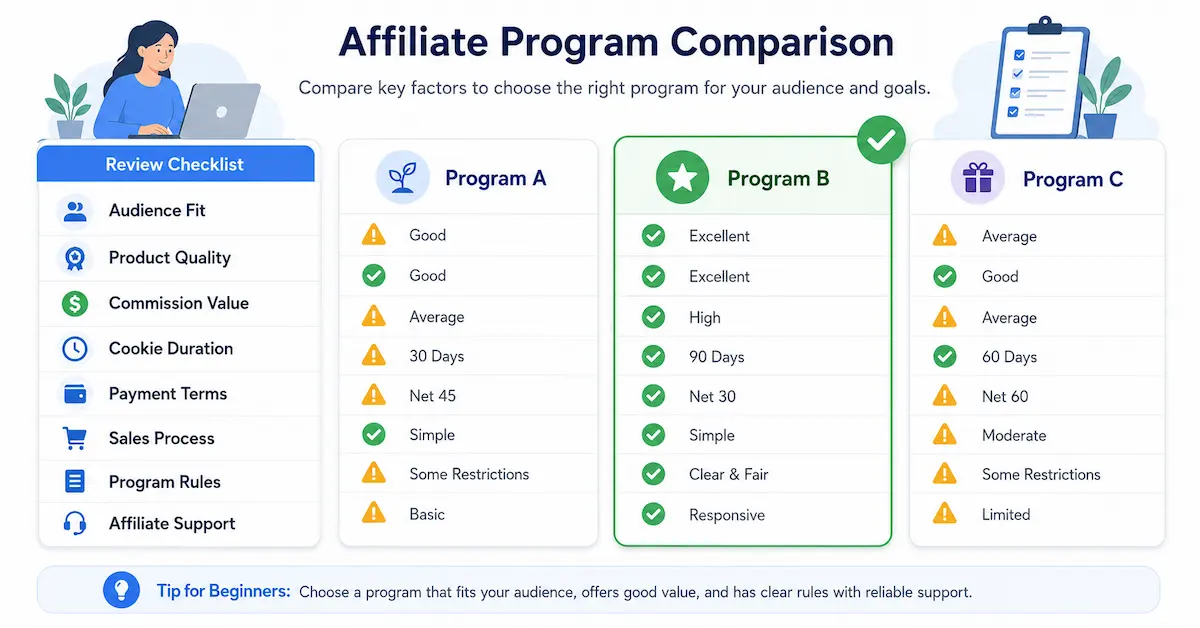
Create a simple comparison sheet and score each option. An affiliate program comparison can help you judge each option using the same criteria.
A comparison checklist makes it easier to understand how to choose an affiliate program that fits your audience.
| Factor | Question |
|---|---|
| Audience fit | Does it solve a real reader problem? |
| Product quality | Have I tested or researched it? |
| Commission | Is the real earning potential fair? |
| Tracking | How long is the cookie, and who gets credit? |
| Payment | When and how will I be paid? |
| Sales process | Is the merchant’s website clear and trustworthy? |
| Rules | Can I use my planned promotion methods? |
| Support | Are help and useful resources available? |
A lower-paying program with a trusted product and strong conversions may outperform a higher-paying offer with poor service.
Free affiliate programs for beginners can also be worth considering.
However, free entry does not guarantee good products, reliable tracking, or fair payment terms.
Judge every program using the same standards.
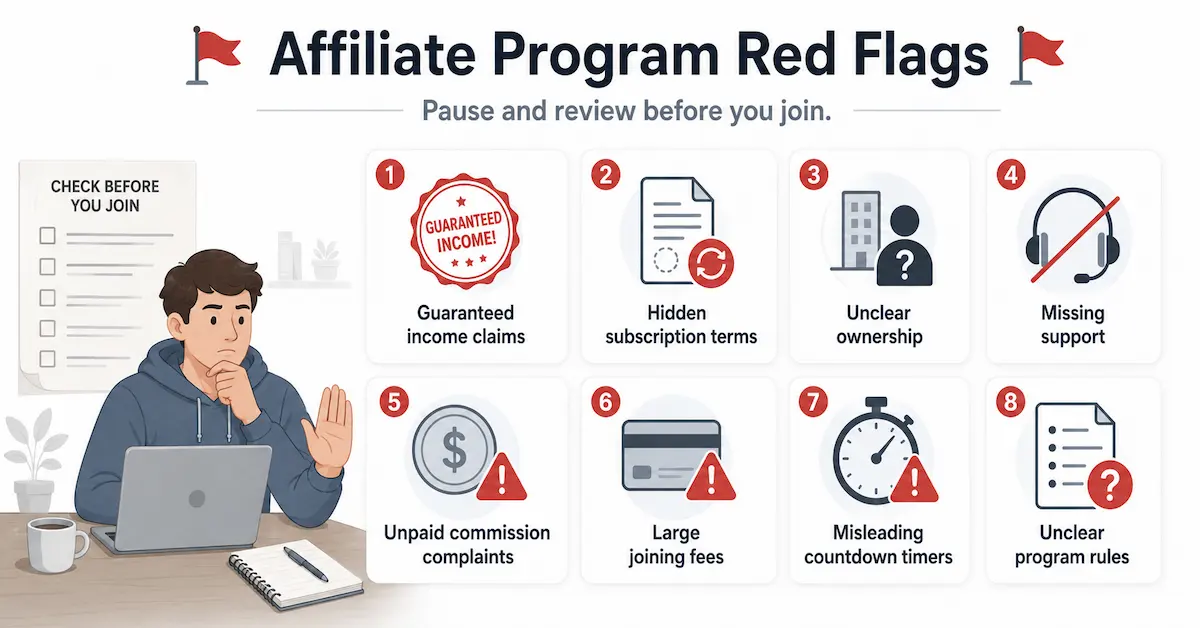
Affiliate Program Red Flags to Avoid
Be careful when a program has unclear ownership, unrealistic income claims, poor customer reviews, missing contact details, or no written terms. These warning signs are also covered in the guide to affiliate marketing mistakes beginners should avoid.
Other warning signs include:
- Large fees merely to become an affiliate
- More focus on recruitment than customer value
- Guaranteed income or results
- Hidden subscription terms
- Repeated complaints about unpaid commissions
- No response from affiliate support
- Misleading countdowns or pressure tactics
- Unclear refund and cancellation policies
One complaint does not prove a company is unreliable.
Look for repeated patterns across several trustworthy sources.
A Simple Three-Step Selection Method
You don’t need a complicated system to compare programs.
Step 1: Create a Shortlist
Find three to five programs that match your niche and audience.
Do not apply immediately.
- Save each program and review its product, company, terms, and customer experience.
Step 2: Score Each Program
Rate each program from one to five for:
- Product quality
- Audience fit
- Commission value
- Tracking
- Payment terms
- Merchant trust
- Affiliate support
This helps you compare programs fairly instead of being distracted by one high commission rate.
Step 3: Test Your Choice
Choose one or two programs and create useful content around them. Then learn how to promote affiliate products without being pushy.
Once you have chosen a suitable program, these affiliate marketing content ideas can help you turn reader questions into useful guides, reviews and comparisons.
The next step is explaining it clearly. This guide shows you how to write a product review that covers the product fairly without turning the article into a sales pitch.
Track clicks, approved commissions, refunds, conversions, and reader feedback.
Keep programs that serve your audience and provide fair results.
Replace a program when the product, customer service, tracking, or terms no longer meet your standards.

Frequently Asked Questions
What should a beginner look for in an affiliate program?
To understand how to choose an affiliate program, start by checking audience fit, product quality, commission value, tracking and cookie duration, payment terms, support, merchant reputation, and rules.
Clear terms and a useful product matter more than a large advertised commission.
Is a high commission rate always better?
No. A high rate may come with poor conversions, high refunds, weak demand, or an expensive product.
Compare the actual commission amount, customer experience, conversion potential, and likelihood of a completed sale.
What is a good affiliate cookie duration?
There is no perfect cookie duration.
Longer cookies can help when buyers need more time to make a decision. However, attribution rules and tracking reliability also matter.
Review the full tracking policy before joining.
Should I join several affiliate programs at once?
Most beginners should start with a small number.
This makes it easier to understand the products, create focused content, follow program rules, and measure results.
Add more programs when they solve different audience needs.
Do I need to use a product before promoting it?
Personal use is best for detailed reviews.
When testing is not possible, research the product carefully and explain the basis of your recommendation.
Never claim to have used a product when you have not.
How often should I review an affiliate program?
Review your main programs every few months.
Check commission rates, product pricing, customer feedback, payment history, cookie terms, support quality, and updated program rules.
Update or remove recommendations that no longer serve your audience.
Want to see how affiliate marketing works?
A good training program can help you understand products, traffic, content, and commissions in a more structured way.
See the full details here… Free to join.
Final Thoughts
Learning how to choose an affiliate program is an important part of building a trusted affiliate business.
Start with your audience.
Check the product, merchant, commission structure, cookie duration, payment terms, sales process, tracking, and rules.
Do not select an offer only because it promises a large commission.
A useful product with fair terms makes honest promotion easier.
It also gives your audience a better experience.
The easiest affiliate programs for beginners are usually those with clear rules, trusted products, simple dashboards, and helpful support.
You do not need to find the perfect program on your first attempt.
Choose carefully, test your results, and review each partnership over time.
Take the Next Step
Do not collect affiliate links without a plan.
- Choose one program that closely matches your audience.
- Read its terms.
- Test the product where possible.
- Check the commission, cookie duration, payment rules, and customer experience.
- Then write down three honest reasons why you would recommend it.
Use those reasons to create one helpful article that answers a real buyer question.
Continue with the Affiliate Marketing for Beginners pillar page to see how content, traffic, trust, affiliate links, and commissions work together.
Continue Your Online Business Journey
Explore more resources to help you build and grow your online business.
Recommended Reading
New Here?
Start with the beginner roadmap and learn the fundamentals of affiliate marketing and online business.
Start HereReady For The Next Step?
Discover the complete system I use to build and grow an online business.
Join Profit Club