

Is Affiliate Marketing Legit? What Beginners Should Know
You may have seen people making bold claims about affiliate marketing.
Some promise quick money. Others claim you can earn thousands while doing almost nothing.
Then you see expensive courses, screenshots of large payments, and social media posts filled with luxury cars.
It is reasonable to ask one simple question:
- Is affiliate marketing legit?
Yes, affiliate marketing is a legitimate way to earn money online.
It is a real marketing method used by established companies, online stores, software businesses, and content creators.
However, that does not mean every affiliate program, course, or income claim is trustworthy. Use these checks to choose an affiliate program more carefully.
Affiliate marketing itself is legitimate.
The problems usually come from dishonest people, poor-quality products, misleading claims, and unrealistic promises.
This guide explains how affiliate marketing really works.
It also shows you how to recognise legitimate opportunities and avoid common affiliate marketing scams. For a question-led examination, read Is Affiliate Marketing a Scam?
Affiliate disclosure: This article may contain affiliate links. If you purchase through one of these links, I may earn a commission at no additional cost to you. I only recommend resources that I believe may be useful for beginners.
What Is Affiliate Marketing?
Read the full beginner explanation of what affiliate marketing is and how it works if you need the complete process before assessing its legitimacy.
Affiliate marketing is a performance-based marketing system.
A business pays you a commission when someone completes an action through your special affiliate link.
That action may include:
- Buying a product.
- Starting a free trial.
- Creating an account.
- Subscribing to a service.
- Requesting a quote.
For example, you might write a helpful article about website hosting.
Inside that article, you recommend a hosting company and include your affiliate link.
- A reader clicks your link and purchases a hosting plan.
- The hosting company tracks the sale and pays you a commission.
- The customer normally pays the same price.
- The business pays your commission from its marketing budget.
Amazon describes its Associates Program as an affiliate marketing program that helps creators, publishers, and bloggers earn from qualifying purchases generated through their recommendations.
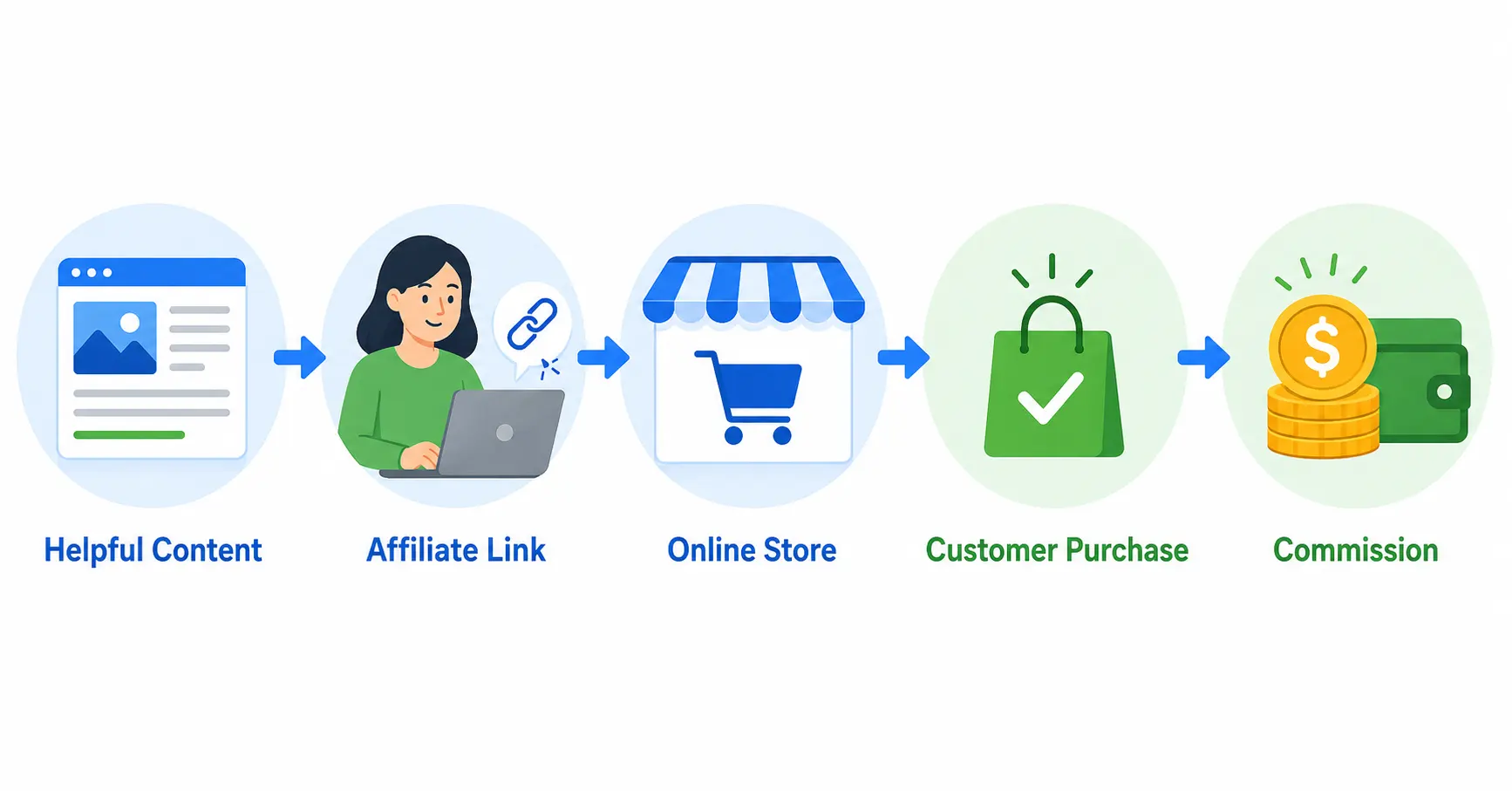
That is the basic affiliate marketing model:
Helpful content → affiliate link → customer purchase → commission
Is Affiliate Marketing Legitimate?
Yes, affiliate marketing is legitimate when it is conducted honestly.
It is simply a way for businesses to pay people who send them customers.
Traditional businesses already use similar arrangements.
- A property agent receives a commission after selling a house.
- A salesperson may earn a commission after selling a vehicle.
- A referral partner may receive payment for introducing a new client.
Affiliate marketing applies that same idea online.
- The affiliate recommends a product.
- The company tracks the referral.
- The affiliate gets paid when the referral produces an approved result.
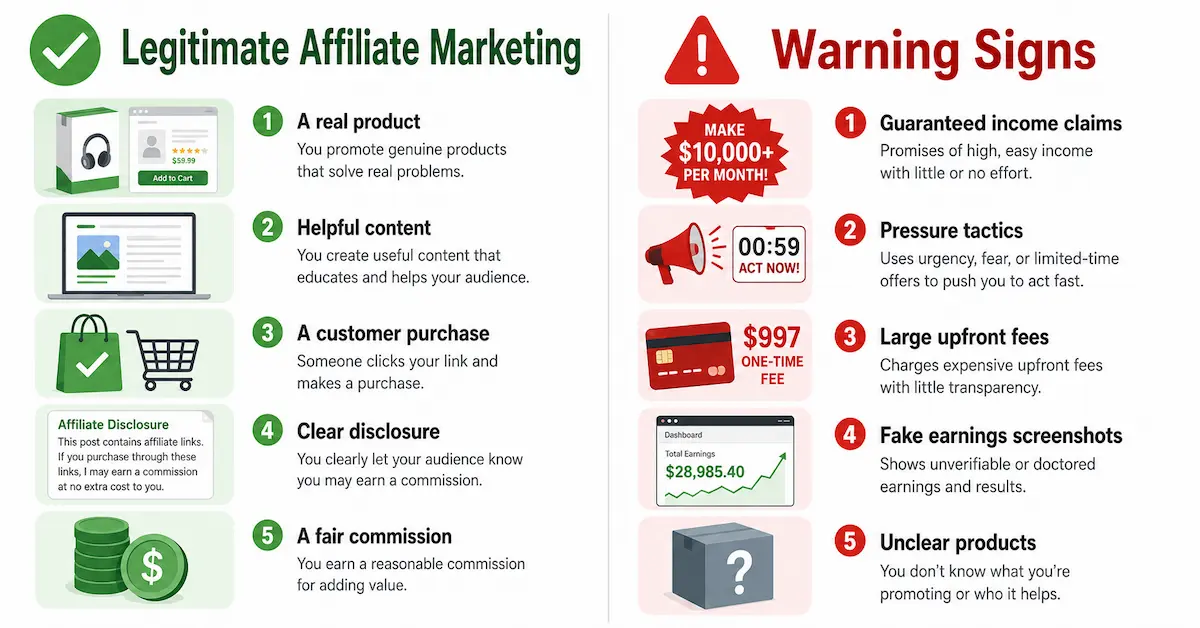
The model becomes questionable when someone:
- Hides their financial relationship.
- Promotes products they do not understand.
- Makes false income claims.
- Recommends poor products only for commissions.
- Uses fake reviews or testimonials.
- Pressures people into expensive programs.
- Earns mainly by recruiting new members.
Those actions are not required by affiliate marketing.
They are examples of people using dishonest marketing methods.
Is Affiliate Marketing a Pyramid Scheme?
No. Legitimate affiliate marketing is not a pyramid scheme.
The main difference is where the money comes from.
With affiliate marketing, you earn money by referring customers to real products or services.
You do not normally receive payment for recruiting more affiliates.
A legitimate affiliate arrangement looks like this:
- A company has a real product.
- You join its affiliate program.
- You receive a tracked link.
- You recommend the product to an audience.
- A customer buys the product.
- The company pays you a commission.
A pyramid scheme depends heavily on recruitment.
- Participants may need to pay large joining fees.
- They are then encouraged to recruit more participants who also pay fees.
- Very little income may come from real customers outside the scheme.
Be careful when an opportunity focuses more on recruiting affiliates than helping customers.
Ask one important question:
Would people still buy this product if there were no income opportunity attached to it?
If the answer is no, you should investigate further.
Why Does Affiliate Marketing Sometimes Look Like a Scam?
Affiliate marketing has a mixed reputation because some promoters use extreme claims.
You may have seen statements such as:
- “Make $10,000 in your first month.”
- “Earn money without doing any work.”
- “Copy my secret system.”
- “Anyone can become rich in thirty days.”
- “You do not need skills, content, or an audience.”
These claims create false expectations.
Affiliate marketing can produce income.
However, it usually requires time, useful content, targeted traffic, testing, and patience.
Most beginners do not fail because affiliate marketing is fake.
- They fail because they expect immediate results.
- They may also follow poor advice, choose the wrong products.
- or stop before their content attracts enough people.
A legitimate business model can still be promoted in a dishonest way.
That is why you must judge the opportunity, product, and promoter separately from affiliate marketing itself.
Does Affiliate Marketing Really Work?
Yes, affiliate marketing can work.
However, it works best when you treat it like a real online business.
Successful affiliate marketers usually help a specific audience solve a clear problem.
They create content such as:
- Beginner guides.
- Product reviews.
- Tutorials.
- Comparisons.
- Checklists.
- Videos.
- Email newsletters.
- Resource pages.
- Case studies.
The affiliate link supports the content. It should not be the entire purpose of the content.
For example, imagine someone searches for the best email marketing tool for a small business.
- A useful article might compare three tools.
- It could explain their prices, strengths, limits, and ideal users.
The reader gains useful information before seeing any affiliate link.
That approach builds trust.
A page that simply says “buy this now” offers little value.
It is less likely to rank, attract loyal readers, or produce steady commissions.
Can Affiliate Marketing Make You Money?
Affiliate marketing can make money, but income varies greatly.
Your results may depend on:
- Your niche.
- The products you promote.
- Your commission rate.
- The price of the product.
- Your website traffic.
- The quality of your content.
- The reader’s buying intent.
- The company’s sales page.
- The length of the tracking period.
- Refunds and cancelled orders.
- Your audience’s trust.
Consider two different visitors.
One person reads a general article about starting a website.
Another person searches for “best beginner website hosting under $10.”
The second visitor is closer to making a purchase.
That means content aimed at a clear buying decision may convert better.
However, you should not turn every article into a sales pitch.
- Educational content attracts new readers.
- Comparison and review content helps those readers choose products.
Both types of content have a role.
Is Affiliate Marketing Legal?
Affiliate marketing is legal in many countries.
However, affiliates must follow advertising, consumer protection, privacy, tax, and disclosure rules that apply in their location.
One important requirement is transparency.
Readers should know when you may earn money from a recommendation.
In the United States, the Federal Trade Commission says financial and other material connections should be clearly disclosed. It also says the disclosure should be easy to see, understand, and placed with the endorsement itself.
In Australia, the ACCC warns that paid or connected reviews may mislead consumers when the commercial relationship is not stated. It also advises businesses to clearly disclose relevant commercial relationships.
A simple disclosure may say:
This article contains affiliate links. I may earn a commission if you purchase through these links, at no extra cost to you.
Place your disclosure where readers can easily notice it.
Do not hide it at the bottom of a long page.
Laws vary between locations.
Check the rules that apply to your business and audience.
How to Tell Whether an Affiliate Program Is Legit
Do not join a program simply because it offers a large commission.
Research the company first.
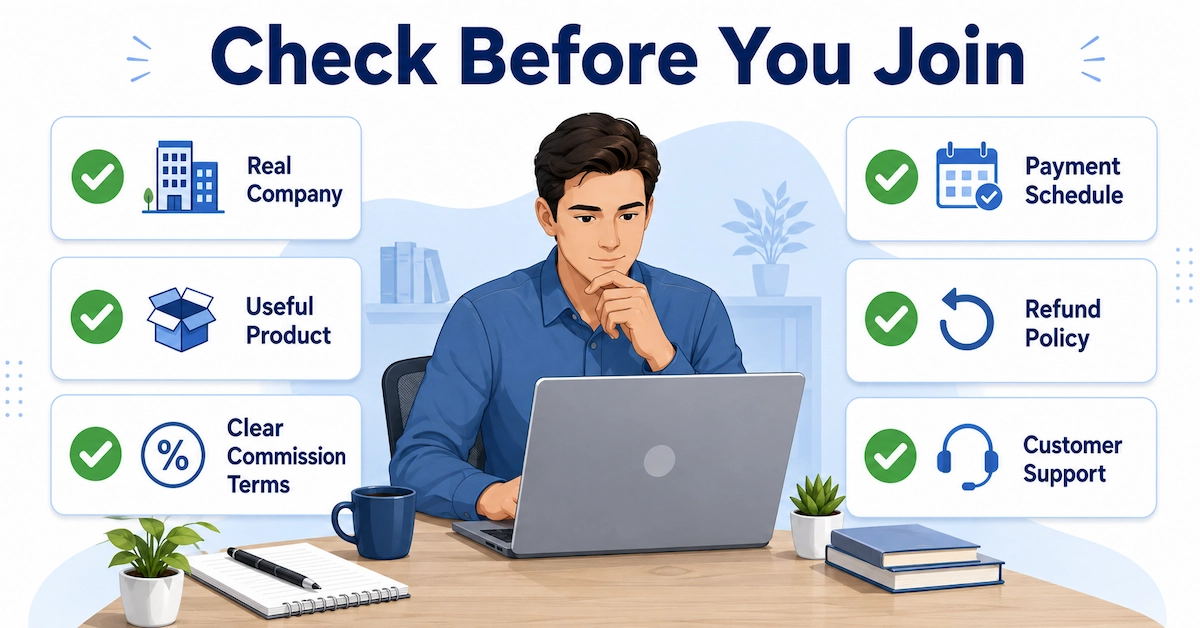
Check the company behind the program
Look for a real business website.
The site should clearly explain what the company sells, how customers receive support, and how refunds are handled.
Check whether the business provides:
- Contact details.
- Terms and conditions.
- Privacy information.
- A refund policy.
- Product information.
- Customer support.
- Affiliate terms.
A missing contact page does not automatically prove fraud.
However, several missing trust signals should make you cautious.
The ACCC’s guide to checking whether a business is genuine provides additional steps you can use to investigate a company before joining or recommending its affiliate program.
Read the affiliate agreement
A legitimate program should explain its rules.
Look for details covering:
- Commission rates.
- Payment methods.
- Minimum payment amounts.
- Payment schedules.
- Tracking periods.
- Prohibited marketing methods.
- Refund deductions.
- Account termination.
- Disclosure requirements.
Do not rely only on claims made by the person promoting the program.
Read the actual agreement.
Examine the product
Ask whether the product provides real value.
- Would you recommend it to a friend or family member?
- Does it solve the problem it claims to solve?
- Does the price make sense compared with similar products?
Avoid promoting something you would not feel comfortable defending.
Search for independent experiences
Look beyond testimonials on the company’s own sales page.
Search for discussions about:
- Missed payments.
- Account closures.
- Refund problems.
- Product quality.
- Customer support.
- Tracking issues.
- Unexpected fees.
Every company may have some negative comments.
You are looking for repeated patterns, not one unhappy customer.
Test support before promoting
Send the company a reasonable question.
- A helpful response can show that real support exists.
- No response does not always mean the business is dishonest.
However, it may show how your future referrals will be treated.
Your reputation can suffer when you recommend a company with poor support.
Affiliate Marketing Scam Warning Signs
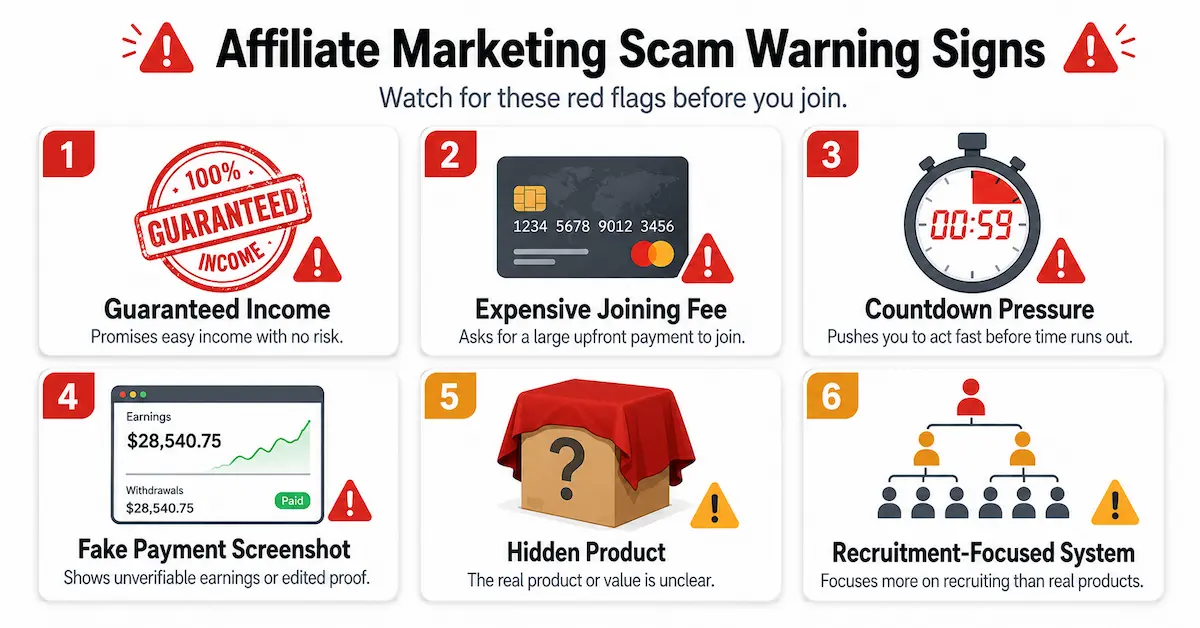
Some warning signs deserve extra attention.
Guaranteed income
No honest affiliate program can guarantee how much you will earn.
Your results depend on many factors outside the program’s control.
Large upfront fees
Some useful affiliate courses and communities charge fees.
However, you should not need to pay a large amount simply to receive permission to promote an ordinary product.
Be especially careful when the main product appears to be access to the same recruitment system.
Pressure to act immediately
Scammers often use false deadlines.
They may claim the opportunity closes in hours, even though the same offer appears every day.
A legitimate company should allow you time to research its terms.
Income screenshots without context
A payment screenshot does not show expenses, refunds, advertising costs, or how long the person worked.
It may also be edited.
Treat screenshots as marketing material, not proof of typical results.
A stronger focus on recruitment than customers
The product should be useful to everyday customers.
The business should not depend mainly on new members paying to join.
Poor or hidden products
Avoid opportunities where you cannot clearly understand what customers receive.
A high commission cannot make a weak product valuable.
Is High-Ticket Affiliate Marketing Legit?
High-ticket affiliate marketing involves promoting expensive products or services.
These may include:
- Business software.
- Professional training.
- Premium memberships.
- Consulting services.
- Specialist equipment.
- High-level events.
High-ticket affiliate marketing can be legitimate.
However, the higher price often creates more room for exaggerated claims.
Do not assume an expensive offer is better.
Check the product, company, refund terms, customer support, and sales process.
You should also consider whether the product suits your audience.
A large commission should never be your only reason for recommending something.
Is Affiliate Marketing Safe for Beginners?
Affiliate marketing can be a relatively low-cost business model.
You do not normally need to create a product, hold stock, package orders, or manage shipping.
However, it still has risks.
You may spend money on:
- Website hosting.
- Email marketing tools.
- Content software.
- Training.
- Paid advertising.
- Freelance services.
Start with a small budget.
Avoid buying every tool recommended by successful marketers.
You usually need only a website or publishing platform, a content plan, a traffic method, and a suitable affiliate program.
Free traffic methods can take longer.
Paid advertising can produce faster data but also creates a greater financial risk.
Beginners should usually learn the basics before spending heavily on advertising.
How to Start Affiliate Marketing Safely
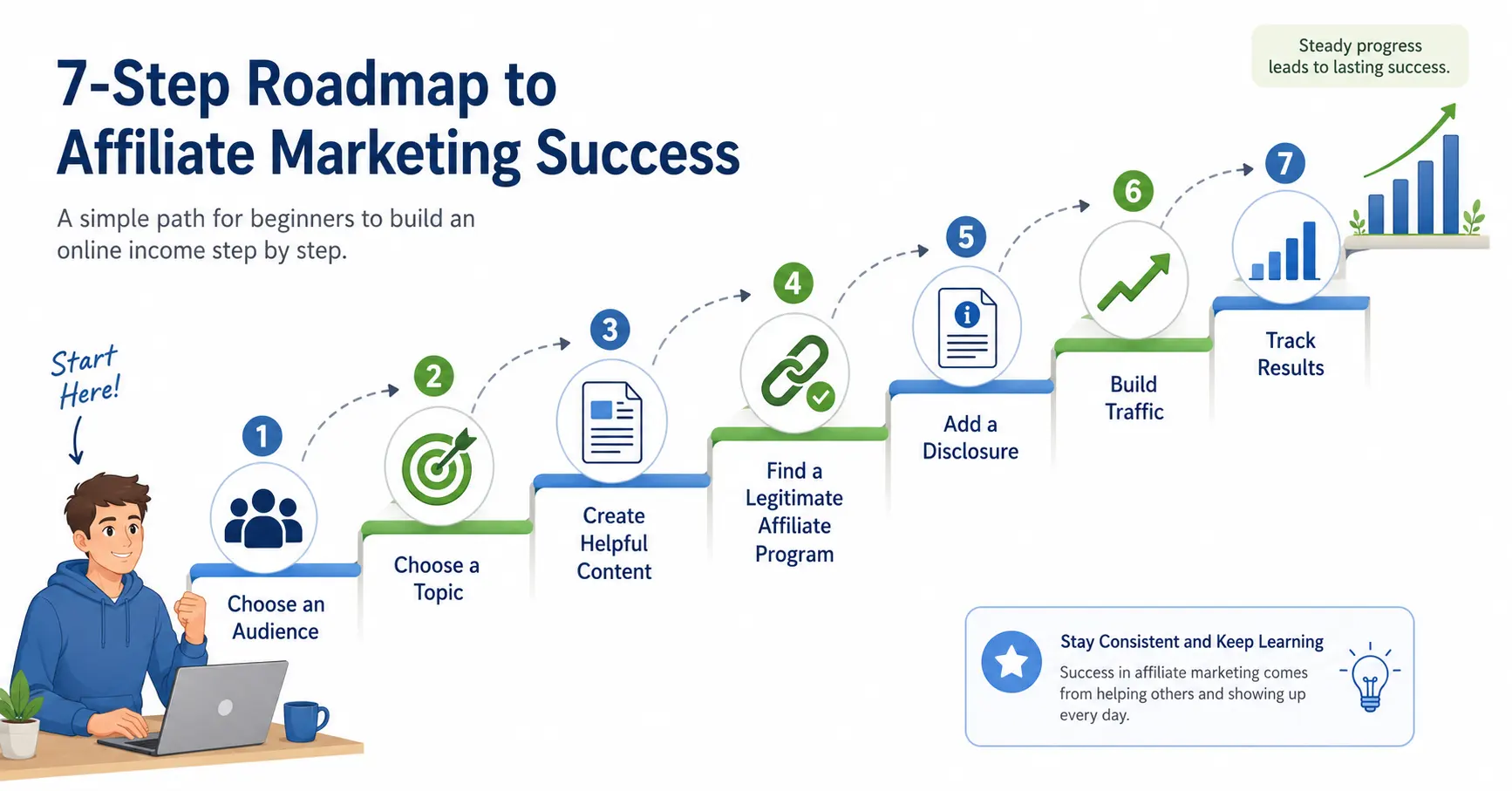
The detailed affiliate marketing starter guide explains the full sequence from niche selection to content, disclosure and traffic.
Use a simple process.
Step 1: Choose a clear audience
Decide who you want to help.
- “People who want to make money” is too broad.
- “Adults over 40 starting their first affiliate website” is more focused.
Step 2: Choose a useful topic
Select a subject that gives you enough room to create helpful content.
- You do not need to be the world’s leading expert.
- You need to research carefully and explain things clearly.
Step 3: Create trustworthy content
Answer real questions.
- Show both advantages and limitations.
- Do not copy product descriptions or publish empty reviews.
Step 4: Join relevant programs
Choose products that match the problems discussed in your content.
- Check the company and read the affiliate agreement.
Step 5: Add clear disclosures
Tell readers when you may receive a commission.
Transparency protects trust.
Step 6: Build traffic
Learn one traffic method before trying everything.
Search engine optimisation, social media, video, email, and online communities can all work.
Step 7: Track your results
Measure clicks, conversions, commissions, and popular content.
Use that information to improve your next article.
Is Affiliate Marketing Worth It?
Affiliate marketing may be worth it when you:
- Enjoy creating useful content.
- Are willing to learn marketing.
- Can work without immediate rewards.
- Want to build a long-term online asset.
- Prefer recommending products rather than creating them.
- Understand that income is not guaranteed.
It may not suit you when you:
- Need guaranteed income immediately.
- Dislike writing, recording, or communicating.
- Expect a fully passive business from the beginning.
- Do not want to learn about your audience.
- Plan to promote any product offering a large commission.
Affiliate marketing becomes more valuable as your content, audience, and experience grow.
An older article can continue bringing visitors.
An email list can help you reach readers again.
Trust can improve the results of future recommendations.
However, these assets take time to build.

Frequently Asked Questions
Is affiliate marketing legit for beginners?
Yes. Beginners can join legitimate affiliate programs and earn commissions from their recommendations. They still need to research products, create useful content, disclose affiliate relationships, and attract the right audience.
Is affiliate marketing a real business?
Yes. Affiliate marketing can operate as a real online business. You create content, attract potential customers, recommend relevant products, track results, and earn commissions from approved actions.
Are affiliate programs legit?
Many affiliate programs are legitimate, but not all programs are equally trustworthy. Research the company, product, payment terms, support, and affiliate agreement before joining.
Is affiliate marketing a pyramid scheme?
Legitimate affiliate marketing is not a pyramid scheme. Affiliates earn from product sales or customer actions. Pyramid schemes usually depend heavily on recruiting new paying members.
Does affiliate marketing really work without a website?
It can work through social media, video platforms, email, podcasts, or online communities. However, each platform has its own rules. A website gives you more control over your content and audience.
Can affiliate marketing make you rich?
It can produce significant income for some people, but there is no guarantee. Avoid anyone who promises fast or certain wealth. Most successful affiliates build skills, content, traffic, and trust over time.
Is high-ticket affiliate marketing legit?
It can be legitimate when the product provides genuine value and the company uses honest sales methods. Higher commissions do not automatically mean the offer is trustworthy.
Thinking about promoting products online?
Affiliate marketing is one of the simplest online business models to understand. The key is learning the right steps in the right order.
Learn more here
Final Thoughts
So, is affiliate marketing legit?
Yes. Affiliate marketing is a legitimate business model.
- Major companies use it to attract customers.
- Publishers and content creators use it to earn income from useful recommendations.
But legitimate does not mean easy, automatic, or risk-free.
- You still need to choose trustworthy companies.
- You need to recommend suitable products.
- You must disclose your affiliate relationships and avoid misleading claims.
Most importantly, you need to help people before asking them to buy.
- Start with useful content.
- Build trust through honest recommendations.
- Treat your readers like real people, not clicks.
That approach will not produce overnight riches.
However, it gives you a much stronger foundation for building a genuine affiliate marketing business.
Ready to Learn How Affiliate Marketing Works?
Affiliate marketing becomes easier to understand when you see the complete process.
Read our Affiliate Marketing for Beginners pillar guide to learn how affiliate links work, how commissions are tracked, how to choose products, and how to start building your first affiliate marketing business.
Explore more resources to help you build and grow your online business. Start with the beginner roadmap and learn the fundamentals of affiliate marketing and online business. Discover the complete system I use to build and grow an online business.
Continue Your Online Business Journey
Recommended Reading
New Here?
Ready For The Next Step?