

How to Write an Affiliate Product Comparison Post
Choosing between two similar products can be surprisingly difficult. One has a lower price, another has more features, and both sales pages insist they are the better choice.
That is where a useful product comparison post can help.
Instead of trying to push one product, your job is to make the differences easier to understand. A good comparison helps the reader work out which option is more suitable for their needs, budget and level of experience.
For an affiliate marketer, this matters because the reader may already understand the type of product they need. What they want now is a fair explanation of the choices in front of them.
Affiliate disclosure: This article may contain affiliate links. If you purchase through one of these links, I may earn a commission at no additional cost to you. I only recommend products or services I believe may be useful to readers.
What Is a Product Comparison Post?
A product comparison post is an article that compares two or more products that solve a similar problem.
You might compare two email marketing services, website tools, training programs or products within the same category.
The important part is that the comparison has a reason to exist. If one product is designed for a complete beginner and another is aimed at a large business, putting them side by side may not help very much.
This is different from a single product review.
A review asks, “Is this product worth considering?”
A comparison asks, “How does this option differ from the alternatives?”
If you’re still learning how reviews work, my guide to writing an honest product review explains the single-product approach in more detail.
When Does a Comparison Work Better Than a Review?
A comparison works particularly well when the reader’s real question involves a choice.
For example:
- Product A vs Product B
- Which email tool is easier for a beginner?
- Which website builder offers the features I actually need?
- Which of these two services represents better value for my situation?
That reader doesn’t need another long description of each product. They need help deciding what the differences mean.
A comparison blog post can work especially well at this stage because it lets you put the alternatives side by side. My guide to affiliate marketing content explains where comparisons fit alongside reviews, tutorials and beginner guides.
This is why a good affiliate product comparison should go beyond copying feature lists. Features matter, but the reader normally wants to know how those features affect their decision.
1. Choose Products That Belong in the Same Decision
The first step is choosing products that make sense to compare.
They don’t have to be identical, but they should solve broadly the same problem for broadly the same type of person.
Imagine two email marketing services. One may be simpler and cheaper, while the other offers more advanced automation. That can still be a useful comparison because a beginner may genuinely be deciding between them.
Before writing, ask:
- Would the same reader realistically consider both products?
- Do they solve the same main problem?
- Are the differences meaningful enough to explain?
- Can I compare them using the same basic criteria?
If the answer is yes, you probably have a sensible topic for a product comparison post.
2. Decide What Matters Before You Compare Features

One common mistake is to open both product websites and start listing features.
That can produce a long article without actually helping the reader.
Instead, decide what matters to the person making the choice.
For a beginner comparing email tools, useful criteria might include price, ease of setup, list limits, automation, support and what happens as the list grows. For a website tool, the important points could be ease of use, flexibility, support and ongoing cost.
The criteria should come from the reader’s decision, not from whichever features the companies promote most heavily.
Looking at a few product comparison examples can help you see how other writers organise this information, but don’t automatically copy their criteria.
A comparison of two cameras, for example, may focus heavily on technical specifications. A comparison of two beginner email services may need much more emphasis on ease of use, support and ongoing cost.
The useful question is always:
What would actually help this particular reader choose?
3. Research Both Products to the Same Standard
A balanced comparison needs balanced research.
Use the same basic process for each product. Check official product information, pricing, important limitations, support options, cancellation or refund terms where relevant, and any conditions that could affect a buyer.
If you have personally used the products, your own observations can add useful context. Screenshots and specific examples can also make a comparison more credible.
If you haven’t used one or both products, don’t write as though you have. Explain the basis of the comparison and stick to information you can verify.
Google’s guidance for high-quality review content recommends evaluating products from the user’s perspective, explaining important differences, covering benefits and drawbacks, and providing original evidence where possible.
The practical lesson is simple: give the reader something more useful than a rewritten sales page.
4. Build a Useful Product Comparison Table
A product comparison table is one of the easiest ways to help a reader understand the main differences quickly.
It works particularly well near the beginning of the comparison because some visitors will want the short version before they read the detail.
Keep the table focused on the factors that matter most. You don’t need to include every feature either company offers.
For example:
| Question | Product A | Product B |
|---|---|---|
| Best suited to | Beginners who value simplicity | Users needing advanced features |
| Setup | Simpler | More involved |
| Main strength | Ease of use | Greater flexibility |
| Main limitation | Fewer advanced options | Steeper learning curve |
| Pricing approach | Lower starting cost | Higher starting cost |
A good product comparison table gives the reader orientation. It isn’t meant to replace the article.
If the table says one product is easier to use, explain what makes it easier. If one costs more, explain whether the higher price comes with features a beginner is likely to need.
That is what turns a simple comparison chart into useful guidance.
Be careful with prices, limits and feature claims because they can change. Check them before publishing and again when you update the article.
5. Explain the Difference, Not Just the Feature
This is where a product comparison post becomes genuinely useful.
Suppose Product A has a basic automation builder and Product B has a more advanced workflow system.
A feature list leaves the reader to interpret that difference. A better explanation might be:
Product A may be easier for someone creating their first welcome sequence because there are fewer settings to learn.
Product B may suit someone who already knows they need branching workflows and more detailed automation.
You haven’t declared either product universally better. You’ve explained when the difference matters.
Use that approach throughout the article. Translate features into practical consequences for the reader.
6. Explain Who Each Product Is Best Suited To
A comparison doesn’t always need one winner.
In many cases, the most useful conclusion is that different products suit different people.
You might say:
Choose Product A if you want the simplest route to getting started and don’t need advanced controls.
Consider Product B if you’re comfortable with more complexity and expect to use the additional features.
It’s also fine to explain when neither product is ideal. Perhaps both are more than a beginner needs right now.
The aim of affiliate content isn’t to make every reader buy something. It’s to help the right reader make a better-informed choice.
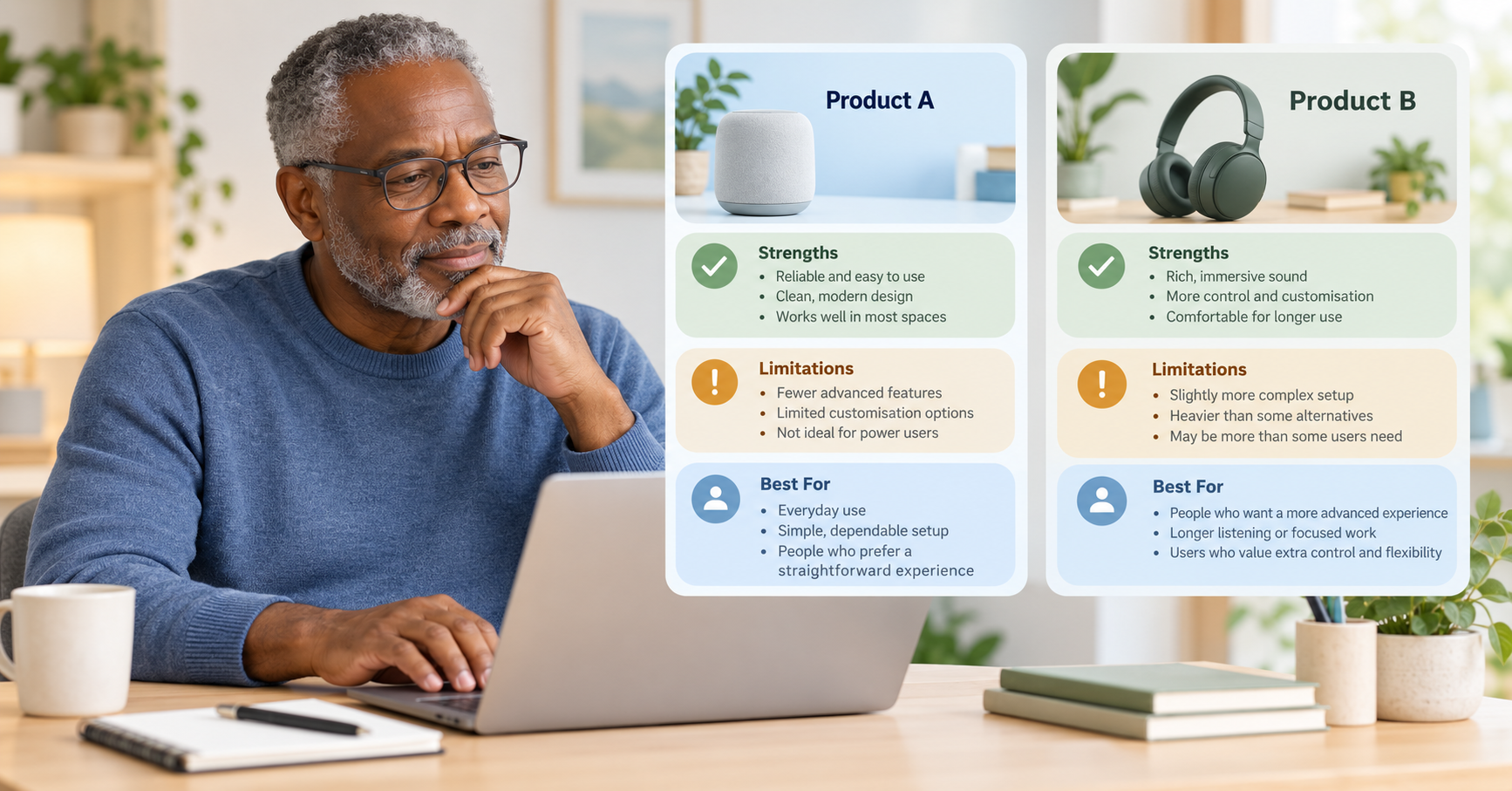
7. Include Limitations as Well as Strengths
Every worthwhile product has limitations.
Leaving them out can make a comparison sound like advertising rather than guidance.
Concentrate on limitations that affect the decision, such as a missing feature on a lower-priced plan, a steeper learning curve, limited support, extra charges as usage grows or restrictions that matter to a particular type of user.
Apply the same standard to both products.
Readers don’t expect every option to be perfect. They usually want to know which compromises they can live with.
This is also something worth noticing when you study good product comparison examples. The more useful ones don’t simply stack advantages on either side. They make the trade-offs clear.
8. Use Affiliate Links Without Letting Them Control the Comparison
A product comparison post may contain affiliate links to one or more products.
That commercial relationship should be clear.
The US Federal Trade Commission says affiliate relationships should be disclosed clearly and conspicuously, with the disclosure close enough to the recommendation for readers to understand the connection.
In practical terms, put a clear disclosure near the beginning and don’t make readers hunt for it.
You can also keep link placement restrained. There’s usually no need for a button after every paragraph. A few well-placed links after you’ve explained the product can be enough.
If you want wording you can adapt, my affiliate disclosure examples guide includes examples for comparison articles as well as reviews, email and social media.
9. Finish With a Useful Recommendation, Not a Forced Winner
The final section should help the reader act on what they’ve learned.
Bring the comparison back to the main differences:
Choose Product A if your priority is simplicity, a lower starting cost and an easier learning curve.
Choose Product B if you need more advanced control and are comfortable spending more time learning the system.
If neither difference matters yet, you may be better off delaying the decision until you know what you actually need.
Not every reader has to buy today.
A strong product comparison post should leave the reader clearer than when they arrived, even if their decision is to keep researching.
A Simple Product Comparison Post Structure You Can Reuse
Before writing your first comparison, it can be useful to study a few product comparison examples from your own niche.
Look at how they introduce the products, which decision factors they cover, whether they use a product comparison table, how clearly they explain limitations and whether the conclusion genuinely helps the reader choose.
Don’t copy their wording or structure blindly. Use them to understand the questions readers are likely to expect you to answer.
A practical structure for your own article is:
- Introduce the decision the reader is trying to make.
- Add your affiliate disclosure.
- Explain briefly what each product does.
- Add a simple product comparison table.
- Compare the most important decision factors.
- Explain strengths and limitations.
- Say who each product may suit.
- Answer common questions.
- Finish with a conditional recommendation.
Once you’ve used the structure a few times, the important work is deciding what genuinely matters in each comparison rather than simply filling in a template.
Want a Clearer Affiliate Marketing Starting Point?
Comparison posts are one part of affiliate marketing. You still need suitable products, useful content and relevant traffic.
If you’d prefer a structured way to work through those pieces, you can take a look at CB Profit Club and decide whether it suits where you are now.
There are no guaranteed results; the value is in having a clearer process to follow.

Frequently Asked Questions
What Is an Affiliate Product Comparison Post?
An affiliate product comparison post is an article comparing two or more products that solve a similar problem and may include affiliate links to those products. Its purpose is to explain meaningful differences such as price, ease of use, features, limitations and who each option suits. It should still help the reader even if they decide not to buy.
Should I Include a Product Comparison Table?
In most cases, yes. A product comparison table gives readers a quick way to see the main differences before reading the detailed explanation. Keep it fairly short and concentrate on factors that genuinely affect the buying decision. The table should support the article rather than trying to contain every feature each product offers.
How Many Products Should I Compare in One Post?
For a beginner, two products are often enough. That gives you room to explain the important differences without making the article difficult to follow. Three or more can work when readers genuinely need a shortlist, but add another product only when it improves the decision.
Where Can I Find Useful Product Comparison Examples?
Search for comparisons within the same general niche you’re writing about, but look at them for structure and reader questions rather than something to copy. Pay attention to what they compare, how they organise their product comparison table, whether they explain the practical meaning of feature differences and how balanced their recommendations are.
Do I Need to Use a Product Before Comparing It?
First-hand use can make a comparison stronger because you can provide your own observations and evidence. If you haven’t used one or both products, don’t imply that you have. You can compare verifiable information, but be clear about the basis of your research.
Should Every Comparison Post Choose a Winner?
No… One product may be better for a particular purpose, while another suits a different type of user. A conditional recommendation is often more useful than forcing one option to be “best” for everyone.
Final Thoughts

Writing a useful product comparison post isn’t mainly about finding more ways to describe two products. It’s about understanding the decision your reader is trying to make.
Choose products that genuinely belong in the same comparison.
- Decide which differences matter.
- Research both options fairly.
- Use a simple product comparison table to make the main differences easier to see.
- Then explain what those differences mean in practice.
Looking at good product comparison examples can help you understand the format, but the real value comes from applying it to the needs of your own audience.
That takes more work than copying two feature lists, but it produces something far more useful.
A sensible next step is to choose two products your audience already compares and write down the five or six factors that would genuinely influence their decision. Once you have those, the article becomes much easier to structure.
For the wider picture of how comparisons, reviews, affiliate links, content and traffic fit together, continue with the Affiliate Marketing for Beginners guide.
Continue Your Online Business Journey
Explore more resources to help you build and grow your online business.
Recommended Reading
New Here?
Start with the beginner roadmap and learn the fundamentals of affiliate marketing and online business.
Start HereReady For The Next Step?
Discover the complete system I use to build and grow an online business.
Join Profit Club